
THE CHINESE MIRACLE – Shenzhen: From Fishing Village to Global Innovation Hub
By Frank Dumon
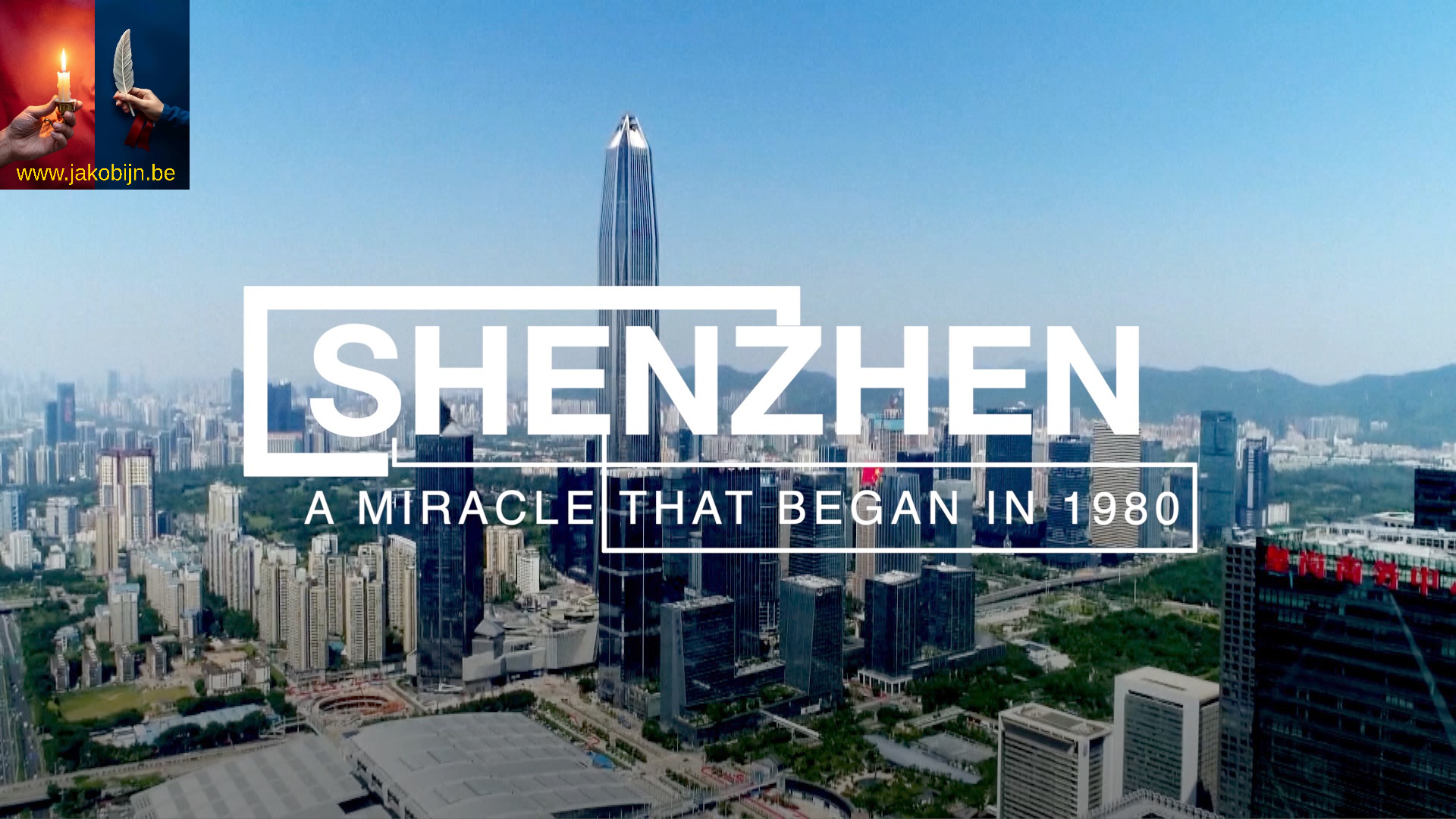
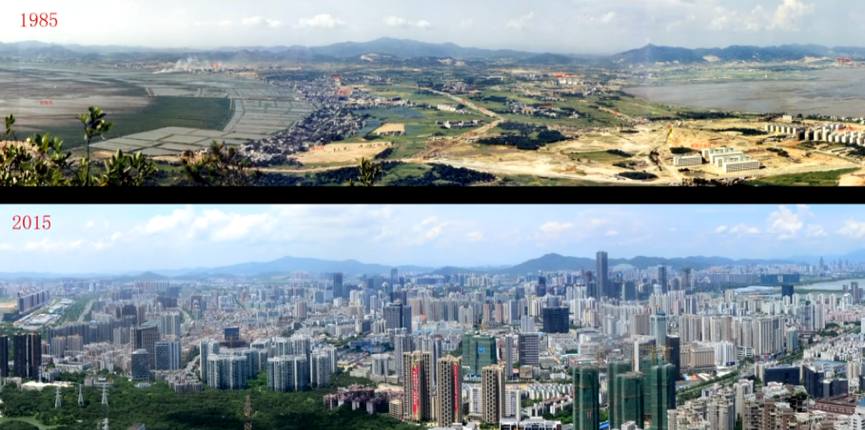
In 1980, Shenzhen was a sleepy fishing village on the Pearl River, with barely 30,000 residents and an economic output of 200 million yuan - roughly equivalent to a mere 25 million euros. Today, thirty-six years later, 17.5 million people officially live in the city, and the gross domestic product amounts to 3.5 trillion yuan, approximately 450 billion euros. A growth factor of 17,500 in less than two generations. No other city in modern history has undergone such a transformation.
The Beginning: A Visionary Decision
The story of Shenzhen begins in December 1978, when Deng Xiaoping launches the policy of "reform and opening-up". The Communist Party had been through a traumatic decade. The Great Leap Forward, the utopian attempt to catch up with Western industry in just a few years, had resulted in a devastating famine that claimed tens of millions of lives. The Cultural Revolution had torn society apart, closed universities, and exiled a generation of intellectuals to the countryside. China stood on the brink of the abyss.
Deng's response was as pragmatic as it was radical. "It doesn't matter whether a cat is black or white, as long as it catches mice," he would later say - a statement that would summarize all of Chinese reform thinking. Ideology had to make way for results. A market economy, once the symbol of the capitalist enemy image, was now embraced as an instrument for national resurrection.
Yet this turnaround was not self-evident. In the 1980s, making a profit in China was still politically incorrect, a legacy of Maoist thinking that equated wealth with capitalist decadence. To convince the population, the government launched a slogan that would summarize all reform thinking: "Time Is Money, Efficiency Is Life". The text appeared on large billboards in Shenzhen, visible to every passerby. It was a conscious break with the past, an ideological justification for what was economically necessary. The slogan became the symbol of a new China, where pragmatism triumphed over dogma.
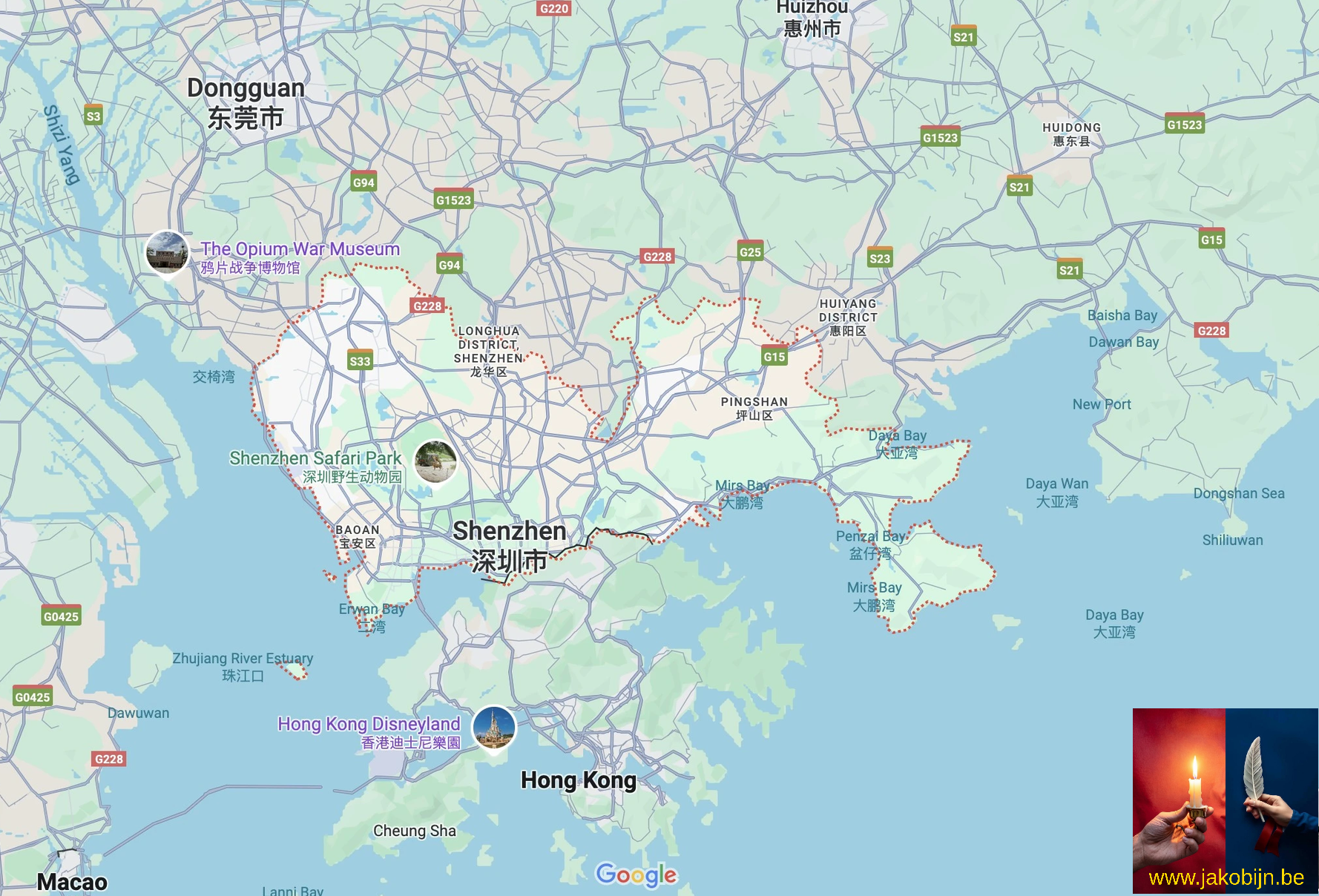
In 1979, Shenzhen was chosen as one of the first Special Economic Zones, alongside Zhuhai, Shantou, and Xiamen. The location was no coincidence. Shenzhen borders Hong Kong, at the time still a British colony and the financial heart of Asia. The city has access to the Pearl River Delta, a natural trade route. And not unimportantly, it lies far enough from Beijing so that experimental reforms would not directly reflect on the capital if they failed.
The financial infrastructure followed quickly. In 1982, foreign banks were allowed for the first time to open branches on the Chinese mainland - a symbolic opening of China's market to the world. Five years later, in 1987, Shenzhen launched the country's first joint-stock bank, breaking the monopoly of state banks and enabling shareholders to buy and sell stocks. In 1990, China opened its first stock exchange in Shenzhen, followed in 1992 by the Shenzhen Stock Exchange, the second on the mainland. Today, that exchange, with a trading volume of over 3.6 trillion dollars, is the eighth largest in the world. It was a gradual but irreversible integration of China into the global financial system.
The First Wave: Factories and Migrants
The first two decades, from 1980 to 2000, transformed Shenzhen into what would soon be called the "factory of the world". Investors from Hong Kong massively relocated their labor-intensive production to the mainland, attracted by wages that were a tenth of what they paid at home, flexible labor regulations, generous tax benefits, and minimal bureaucracy.
Millions of young workers from the interior - mainly from the poor provinces of Hunan, Sichuan, and Jiangxi - flocked to the city. They were given a name: the "dagong mei" (打工妹), the working girls, and the "dagong zai" (打工仔), the working boys. They worked twelve to fourteen hours a day, six days a week, often in conditions that would be completely unacceptable in the West: no social security, no labor rights, barely any future prospects.
Chen, now fifty-eight, came to Shenzhen in 1988 as a nineteen-year-old girl from a village in Hunan. "We slept twelve girls in a room as big as this one," she says. "We sewed T-shirts for American brands, fourteen hours a day. But we earned ten times more than at home, and we sent money back. My brother was able to study thanks to my work."
This generation built Shenzhen with their hands. They accepted what we would call unjust, but they did create the foundation for what was to come. Their sacrifice is rarely visible in the Western debate on China.
The Second Wave: From "Made in China" to "Created in China"
Around 2005, a turning point began. Wages rose, simple assembly became less profitable, and the Chinese government imposed increasingly strict demands on foreign companies: anyone wanting access to the Chinese market had to transfer technology. Shenzhen transformed from an assembly hub into an innovation center.
The city invested heavily in research and development - up to 4.5 percent of the gross domestic product, more than most Western countries. Universities and research institutes, startup incubators, and venture capital arrived. Ironically, after decades of widespread piracy, intellectual property was finally taken seriously and protected as well.
The results are impressive. Huawei, founded in 1987 as a seller of telephone exchanges, is today a world leader in 5G technology with more than ninety thousand patents. Following US sanctions, the company developed its own chips and its own operating system. Tencent, which started in 1998 with the chat application QQ, now owns WeChat with 1.2 billion users and is the world's largest gaming company. WeChat is not just an app, but a "super-app" with which Chinese people pay, book taxis, make appointments, and read news. DJI, founded in 2006 in a dorm room, dominates the global drone market with over seventy percent. BYD, which started as a battery producer, surpassed Tesla in 2023 as the world's largest manufacturer of electric vehicles.
To understand the scale of this transformation, a comparison with Silicon Valley is enlightening. Shenzhen has approximately 12.5 million inhabitants across an area of 1,991 square kilometers - almost four times as many people as Silicon Valley, which has 3.1 million residents across 1,854 square kilometers. Shenzhen's population density is about 6,100 inhabitants per square kilometer, of which 85 percent live in urban areas. Economically, the difference is even greater: gross domestic product per capita is 128,308 dollars in Silicon Valley, while Shenzhen reaches 29,217 dollars. That may seem little by comparison, but it does make Shenzhen one of the wealthiest cities in all of China. The gap in GDP per capita illustrates that Shenzhen has not yet caught up with Silicon Valley in absolute prosperity - but in speed of innovation, hardware prototyping, and population density, it has long surpassed America.
The Ecosystem: Why Shenzhen Works
Shenzhen's success is no coincidence. It rests on a unique ecosystem of five reinforcing elements.
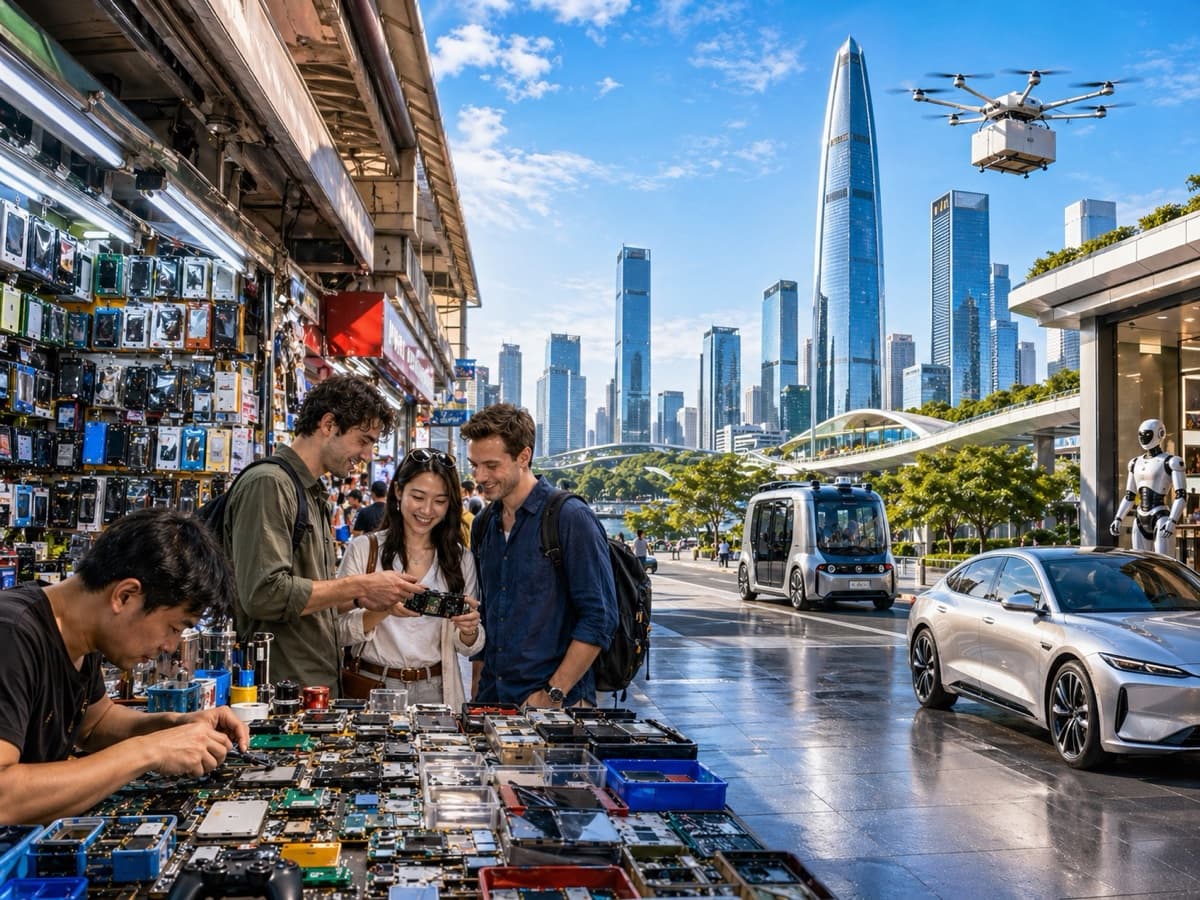
The first is Huaqiangbei, the largest electronics market in the world. Here, every component can be bought, from the smallest chip to complete printed circuit boards, often delivered the same day. Prototypes that take weeks in Silicon Valley are built here in hours. This is why hardware startups worldwide flock to Shenzhen.
The speed of prototyping in Shenzhen is unrivaled. Where a Western company averages twelve to eighteen months to go from idea to working prototype, the same work can be completed in Shenzhen in a mere four to six weeks. This is because prototyping stations are already integrated into the tech markets: one can test various components on-site and evaluate whether they work together. There are hundreds of specialists for every part of the production process, each with the right equipment. In Silicon Valley, by contrast, the process is much slower. There is more focus on a solid research base and outsourcing most work, leading to prototyping times of three to four months. For hardware startups that want to iterate quickly and bring their products to market, Shenzhen is therefore the logical choice.
The second element is the notorious "Shenzhen speed". In 2011, the Broad Group built a fifty-story skyscraper in a mere fifteen days. Permits are approved in days, not months. What takes years in Europe regarding design bureaus, consultation procedures, and lawsuits is realized here in weeks.
What Western observers often do not understand is the phenomenon of Shanzhai (山寨). In Chinese media, it was long portrayed as mere copying, a form of intellectual theft. But the reality is more nuanced. Shanzhai is rather a philosophy of improvement and adaptation. One takes existing technology, dissects it, and builds a better version of it. The mentality in Huaqiangbei is that of open hardware: ideas are shared instead of patented, knowledge is open-source based, and more people can contribute to improving a product. This explains why products that have just been launched in the West are already available in dozens of variants in Shenzhen. It is not criminal energy, but a pragmatic approach that accelerates innovation. Ironically, many of today's large Chinese tech companies - Huawei, Tencent, BYD - emerged from this Shanzhai culture.
The third element is the migratory nature of the city. Ninety-five percent of the population comes from outside Shenzhen. There is no established elite slowing down change, no "not in my backyard" mentality. Everyone is a newcomer, everyone has something to prove.
The fourth element is the local government, which functions as a kind of venture capitalist. It invests in infrastructure, offers subsidies, and attracts talent with housing programs and tax benefits. The fifth element is the unprecedented density of supply chains: within a radius of one hundred kilometers, every supplier is available, from raw materials to finished products.
Lessons for the World
Shenzhen offers important lessons for cities worldwide. The first is that long-term vision prevails over short-term profit. China planned Shenzhen for fifty years, not for the next election cycle. This enables infrastructural projects that are unimaginable in the West due to short-term political thinking.
The second lesson is the principle of local experimentation and national scaling. Special Economic Zones are laboratories. What works in Shenzhen is expanded to other cities. What fails remains locally contained. This gradualism avoids the shock therapy that devastated Russia in the 1990s.
The third lesson is investing in human capital. Shenzhen attracted not only factories, but also universities. Tsinghua, Peking University, and other top institutions now have campuses in the city. The fourth lesson is pragmatism over ideology: Shenzhen combines a market economy with state guidance. The government guides where necessary, but lets the market work where it is more efficient. This state capitalism proves in practice to be more effective than purely liberal or socialist models.
The Price of the Miracle
Every miracle has a dark side, and Shenzhen is no exception. The average house price is 70,000 yuan per square meter, roughly equivalent to 8,500 euros. That is thirty times the average income. Young professionals can no longer afford to buy, which leads to a brain drain to cheaper cities.
The "dagong" generation has no access to social provisions in Shenzhen because of the Hukou system, the internal passport requirement discussed in a later chapter. They paid the price for the transformation, but do not benefit from it. Older migrants who are now too old for factory work return to their villages without a pension or savings.
The ecological costs are also considerable. The Pearl River was biologically dead in the 1990s due to industrial pollution. Although water quality has improved, air pollution remains a problem. Shenzhen is one of China's largest CO2 emitters, even though the city is simultaneously one of the frontrunners in the electrification of the vehicle fleet.
Finally, there is the infamous "996" culture in the tech sector: working from 9 AM to 9 PM, six days a week. This leads to burnouts and is increasingly criticized by young employees, who are organizing themselves into the "lying flat" movement - a form of passive resistance against the endless rat race.
Conclusion: A Model, Not a Blueprint
Shenzhen proves that rapid, large-scale transformation is possible. But it is not a universal model. The city benefited from unique circumstances: proximity to Hong Kong, central government support, a generation of cheap labor, and a globalizing world economy that was open to Chinese exports.
Other cities can learn from the principles - long-term vision, local experimentation, investing in human capital - but cannot replicate the specific circumstances. Yet the story remains inspiring. It shows that poverty is not inevitable, that development is possible within a single generation, and that a country can choose its own path outside Western models.
For the Global South, Shenzhen is not a blueprint, but proof that alternatives exist.
The New Silk Road: An Old Concept in a Modern Jacket
In the autumn of 2013, Chinese President Xi Jinping stood in a lecture hall at Nazarbayev University in Astana, the capital of Kazakhstan. Seated before him was an audience of diplomats, academics, and students from across Central Asia. What he would announce that day would profoundly change the world order.
"Let us breathe new life into the ancient Silk Road," Xi proclaimed, "and create an economic belt that connects our peoples through better connectivity and cooperation." A few weeks later, during a visit to Indonesia, he added a maritime route to it. Together they formed what is known today as the Belt and Road Initiative, or BRI - in Chinese 一带一路, "One Belt, One Road".
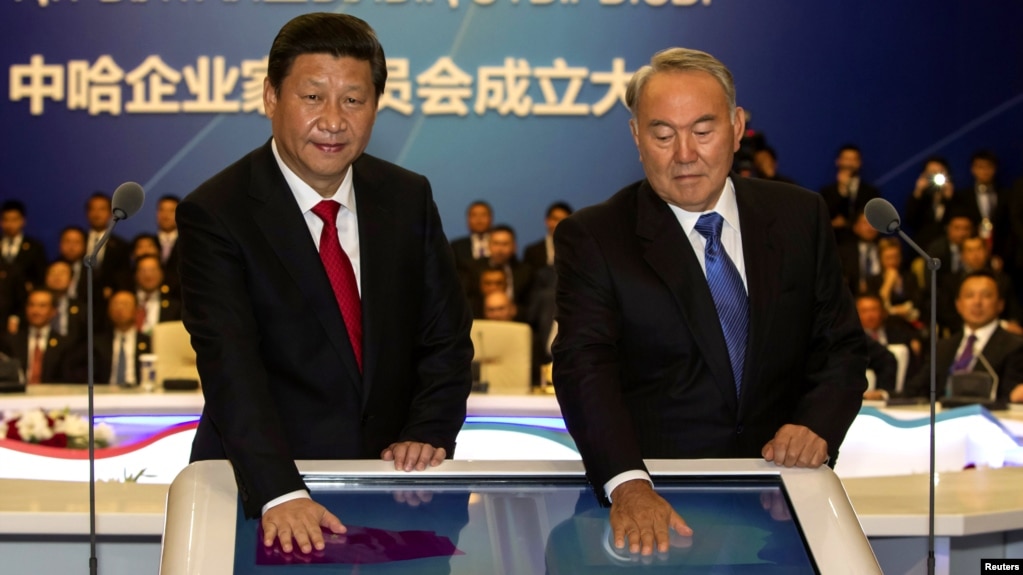
It was no coincidence that Xi made this announcement in Central Asia. The region, rich in natural resources but landlocked and economically left behind since the collapse of the Soviet Union, was the perfect base for a project that would reconnect Asia and Europe. Kazakhstan, with its vast steppes and strategic location between China and Europe, was the logical first partner.
Historical Roots: Two Millennia of Trade
The reference to the Silk Road was more than rhetoric. Two thousand years ago, a network of trade routes already connected China with the Middle East, Central Asia, and ultimately Europe. Camel caravans transported silk, porcelain, spices, and gemstones over thousands of kilometers of desert, mountain, and steppe. But they brought more than goods: ideas, technologies, religions, and cultures flowed along the same routes.
Buddhism traveled from India via the Silk Road to China, where it would have a profound impact on Chinese society. Islam reached Central Asia through the same trade arteries. Paper, gunpowder, and the compass - Chinese inventions that would change the world - found their way to the West and laid the foundation for the European Renaissance and the Industrial Revolution.
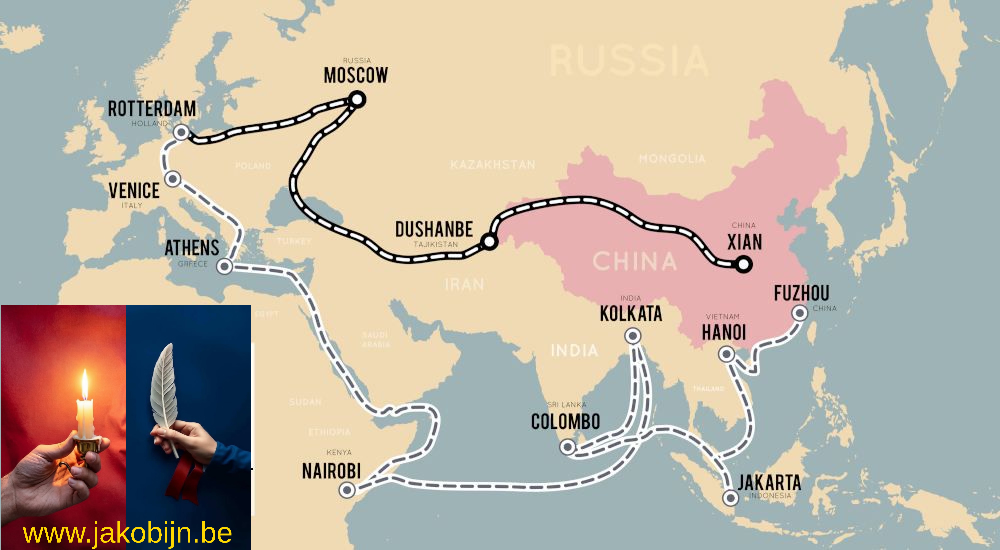
The route experienced its heyday under the Han dynasty (206 BC - 220 AD) and later the Tang dynasty (618-907), when Chang'an (present-day Xi'an) was a cosmopolitan metropolis where merchants from Persia, Arabia, India, and even Europe converged. But the route waned when maritime trade was favored in the sixteenth century. The arrival of European colonial powers and the opening of sea routes around Africa made the land routes largely redundant. Central Asia, once the beating heart of world trade, sank into relative isolation.
The "Century of Humiliation" that China itself would endure - from the Opium Wars to the Japanese occupation - was partly the result of this shift. While Europe grew rich via maritime trade and colonization, China lagged behind. The memory of that time, and of the glory of the Silk Road era, remains deeply embedded in the Chinese collective memory.
The Geopolitical Context of 2013
To understand the BRI, we must look at the world in 2013. The global financial crisis of 2008 had plunged the West into a deep recession. The United States, traditionally the engine of the world economy, struggled with stagnation and political paralysis. Europe wrestled with a debt crisis that threatened to tear the eurozone apart.
At the same time, China had just become the world's largest trading nation and had built up massive overcapacity in sectors such as steel, cement, and construction. Chinese companies, accustomed to double-digit growth, were looking for new markets. The Chinese government, aware of the risks of too rapid a cooling of the domestic economy, sought ways to export this capacity.
There was also a strategic dimension. The Obama administration's "pivot to Asia", with a reinforced military presence in the Pacific and new alliances like the Trans-Pacific Partnership, was viewed in Beijing as an attempt to contain China. The BRI was a response: if the West tried to isolate China, China would create new connections itself, outside the Western sphere.
A Visionary Project
What Xi proposed in 2013 was ambitious: a modern network of infrastructure connecting Asia, Europe, and Africa. Not only roads and railways, but also ports, pipelines, telecommunication networks, and power plants. A physical and digital infrastructure that would facilitate trade, stimulate development, and - not unimportantly - increase China's influence.
The concept caught on. Developing countries, often frustrated by Western conditional aid or the slowness of institutions like the World Bank, saw an alternative in the BRI. Capital finally became available for infrastructure, without the political conditions that Western donors often imposed regarding human rights, good governance, or market reforms.
Today, thirteen years later, the BRI encompasses more than 150 countries and China has invested an estimated more than one trillion dollars in projects worldwide. It is the largest infrastructural development project in human history, larger than the Marshall Plan, larger than European colonization, larger than anything else.
But the project also has opponents. Critics speak of "debt-trap diplomacy", whereby poor countries are deliberately plunged into financial trouble so that China can acquire strategic assets. Others point to environmental damage, corruption, and a lack of transparency. Is the BRI truly a win-win for all involved, or is it an instrument for Chinese hegemony?
To answer these questions, we must look at the concrete projects, the motivations behind the BRI, and the impact on the ground. We will do so in the following parts.
Sources
- Shenzhen Statistical Yearbook 2025, Shenzhen Municipal Bureau of Statistics.
- World Bank Report 2024, "China's Special Economic Zones: Lessons for Development".
- Vogel, Ezra F., "One Step Ahead in China: Guangdong Under Reform", Harvard University Press, 1989.
- McKinsey Global Institute 2023, "China's Innovation Ecosystem: Shenzhen Case Study".
- Annual reports of Huawei, Tencent, DJI, and BYD.
- International Labour Organization 2024, "Working Conditions in China's Tech Sector".
- Chen, Xiangming 2020, "Shenzhen: China's Silicon Valley", Journal of Chinese Economic and Business Studies.
- Silicon Valley Index 2025, Joint Venture Silicon Valley Network.
- Asian Development Bank 2024, "Belt and Road Initiative: Progress and Challenges".
- VICE Documentary 2019, "Shenzhen: The Silicon Valley of Hardware".
- Bloomberg NEF 2025, "Electric Vehicle Outlook".
- König, Michael and Ploier, Florian (2020), "Shenzhen and its comparison to the Silicon Valley", TU Wien Seminar Paper, Creative Commons Attribution-NonCommercial-ShareAlike 4.0 International.
On October 15, I will once again travel to Vietnam and China for three months to conduct interviews there and continue working on my two books. The only potential spoiler may be my health following incorrect treatment by my Belgian doctors. You can read the account on this website under AI & Open Source.
Regarding the Vietnamese quadrilingual book THE PRICE OF ILLUSION - American Veterans versus Vietnamese Survivors, 28 chapters have already been completed. In-depth interviews on site with young and old will further supplement this. A Vietnamese co-author would be ideal, and my friends on site in Hanoi are exploring the possibilities.
Regarding the Chinese quadrilingual book THE CHINESE MIRACLE - 51 Topics under 6 Themes, the 51 articles are ready for further completion:
THEME 1: THE CHINESE MIRACLE
CHAPTER 1: Shenzhen - From Fishing Village to Global Innovation Hub
├─ PART 1/5: Introduction - The Birth of a Miracle
├─ PART 2/5: The Early Years (1979-1992) - Building Something from Nothing
├─ PART 3/5: The Transformation (1992-2010) - From Factory to City
├─ PART 4/5: Shenzhen Today (2010-2026) - The Innovation Capital
└─ PART 5/5: Conclusion and Future - Lessons from Shenzhen
THEME 2: INFRASTRUCTURE AS DIPLOMACY
CHAPTER 2: The Belt and Road Initiative - Infrastructure as Diplomacy
├─ PART 1/6: Introduction + Historical Context
├─ PART 2/6: The Land Route (Silk Road Economic Belt)
├─ PART 3/6: The Maritime Route (21st Century Maritime Silk Road)
├─ PART 4/6: The Digital Silk Road and Latin America
├─ PART 5/6: Critical Reflection
└─ PART 6/6: Conclusion and Sources
THEME 3: POVERTY ALLEVIATION
CHAPTER 3: Poverty Alleviation the Chinese Way - The Last 100 Million
├─ PART 1/5: Introduction - The Largest Poverty Alleviation in Human History
├─ PART 2/5: The Mechanism - Targeted Poverty Alleviation
├─ PART 3/5: Infrastructure and Connectivity - Roads to Nowhere?
├─ PART 4/5: Education and Healthcare - Breaking Intergenerational Poverty
└─ PART 5/5: Conclusion, Critical Reflection, and Sources
THEME 4: ECONOMIC REFORMS
CHAPTER 4: The Special Economic Zones - Laboratories of the Future
├─ PART 1/5: Introduction - The Laboratory Model
├─ PART 2/5: The Four Pioneers - Shenzhen, Zhuhai, Shantou, and Xiamen
├─ PART 3/5: The Second Wave - Shanghai Pudong, Tianjin, and the Inland SEZs
├─ PART 4/5: The SEZs as a Model for the World - From Dubai to Africa
└─ PART 5/5: Conclusion, Critical Reflection, and Sources
THEME 5: GREEN TRANSITION
CHAPTER 5: China's Green Energy Transition - From Coal to Sun and Wind
├─ PART 1/5: Introduction - The Paradox of Polluter and Green Leader
├─ PART 2/5: Solar Energy - How China Caused Global Prices to Plummet
├─ PART 3/5: Wind Energy - From Onshore to Offshore Giants
├─ PART 4/5: Electric Vehicles and Batteries - The Mobility Revolution
└─ PART 5/5: Conclusion, Critical Reflection, and Sources
THEME 6: SOCIAL TRANSFORMATION
CHAPTER 6: High-Speed Trains as a Socio-Economic Instrument
├─ PART 1/5: Introduction - The Largest Rail Network in the World
├─ PART 2/5: The Scale - 45,000 Kilometers in Two Decades
├─ PART 3/5: The Social and Economic Impact - Reducing Inequality
├─ PART 4/5: The Technology - From Import to Innovation
└─ PART 5/5: Conclusion, Critical Reflection, and Sources
CHAPTER 7: 5G and Smart Cities - The Digital Transformation of China
├─ PART 1/5: Introduction - The Digital Empire
├─ PART 2/5: 5G - The Backbone of the Digital Economy
├─ PART 3/5: Smart Cities - The Brain of the City
├─ PART 4/5: Digital Sovereignty - The Struggle for Technological Autonomy
└─ PART 5/5: Conclusion, Critical Reflection, and Sources
CHAPTER 8: The Hukou System - The Invisible Wall in China's Society
├─ PART 1/5: Introduction - Two Classes, One Country
├─ PART 2/5: The History - From Mao to Xi
├─ PART 3/5: The Economic Impact - From Growth Engine to Brake
├─ PART 4/5: The Reforms - From Caution to Ambition
└─ PART 5/5: Conclusion, Critical Reflection, and Sources
CHAPTER 9: The One-Child Policy and the Demographic Challenge
├─ PART 1/5: Introduction - The Paradox of a Policy that Shaped China
├─ PART 2/5: The History - From Mao's Baby Boom to Xi's Three-Child Policy
├─ PART 3/5: The Human Cost - A Generation of Only Children
├─ PART 4/5: The Economic Impact - From Demographic Bonus to Demographic Burden
└─ PART 5/5: Conclusion, Critical Reflection, and Sources
CHAPTER 10: The Future - China, Europe, and the New World Order
├─ PART 1/5: Introduction - A World in Transformation
├─ PART 2/5: The New Cold War - Myth or Reality
├─ PART 3/5: Europe's Choice - Between Washington and Beijing
├─ PART 4/5: Lessons for Europe - What Can We Learn from the Chinese Model?
└─ PART 5/5: Conclusion and Sources - The End of a Journey