
The Decline of the Financial Empire: Why Russia, Iran and China Are the New Architects of the World Order
From Fake GDP Figures and Manipulated Media to the West's Desperate Grab for Raw Materials
By Frank Dumon
The world presented to us by Western media is a mirror image of reality. Washington speaks of a US-led international order. Brussels speaks of a rules-based international order. Financial media rank countries by gross domestic product, stock market capitalization and creditworthiness. But what if these very measures are a deliberately fabricated fiction? What if real power has long since shifted to the countries that control the material economy — Russia, Iran and China?
That is the provocative central thesis of Dr. Fadi Lama in his conversation with The Cradle. Lama, an international adviser to the European Bank for Reconstruction and Development and author of the book Why the West Can't Win: From Bretton Woods to a Multipolar World, argues that the confrontation between the West and the RIC countries (Russia, Iran and China) is not primarily a conventional military conflict. It concerns something more fundamental: who controls the money, who produces the goods, who owns the energy and raw materials, and who can ultimately function without the other side's permission?
His conclusion is radical and irreversible: For decades, the West has confused its financial power with economic power. Meanwhile, China, Russia and Iran have developed different parts of the material economy that are much harder to neutralize through financial sanctions, dollars or aircraft carriers. The RIC countries are not merely survivors — they are the architects of the new world order.
1. The West Has Hardly Any Sovereign States: Big Capital Rules
Lama begins his analysis with an uncomfortable truth rarely expressed in Western media: of the nearly two hundred member states of the United Nations, only a handful are truly sovereign. Sovereignty, after all, requires control over one's monetary policy, natural resources, defense industry and foreign policy. Virtually no Western country meets these criteria.
 The United States itself, according to Lama, is not a sovereign state. The Federal Reserve — the US central bank — is a private corporation, a cartel of major New York banks. Although the Board of Governors may be appointed by the president, real monetary power rests with the private shareholders of the twelve regional Federal Reserve Banks. When a country cannot create its own money without borrowing it from private banks at interest, that country is by definition not sovereign. It is a vassal of financial capital.
The same applies to virtually all NATO countries. Germany, France, the United Kingdom, Italy and the Netherlands — all have privately controlled central banks that belong to the European System of Central Banks, itself dominated by the same financial interests that control the Federal Reserve. The supposedly democratic governments in these countries are puppets. Whether Democrats or Republicans in the United States, Christian Democrats or Socialists in Europe, policy does not change because real power lies not with voters but with the financial elite.
This explains why the West has waged the same wars, imposed the same sanctions and pursued the same economic policies for decades, regardless of who is in power. The two-party democracy in the US and the multiparty democracies in Europe are theater. Real policy is determined by Wall Street, the City of London, and major asset managers such as BlackRock and Vanguard. In China, by contrast, where one party governs, new policies are formulated every five years — bad policies are discarded and good policies retained. That is not dictatorship; it is functional governance.
2. GDP Figures Are Fake — Electricity Consumption Is a More Honest Measure
Here Lama presents his most devastating analysis. The GDP figures that the World Bank, the IMF and Western media present every day are, in his words, "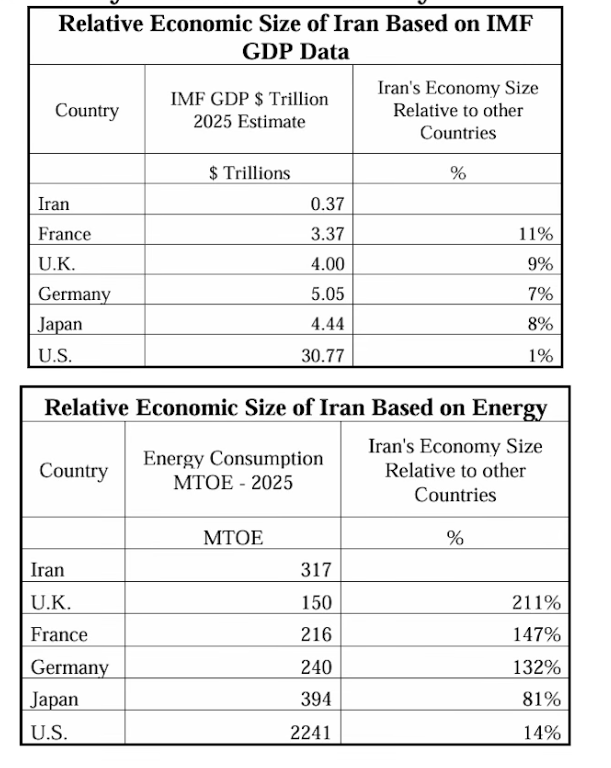 mostly rubbish" — largely nonsense. Why? Because GDP measures themonetary value of goods and services, not material production capacity . A Manhattan lawyer billing $33 million for a consulting assignment generates as much GDP as a factory producing thousands of tons of steel. But their material value is obviously not comparable.The same applies to a haircut. In Mumbai, a haircut costs 20 cents; in New York, $200. The result is exactly the same: shorter hair. Yet in GDP statistics, the New York haircut counts a thousand times more. This is no coincidence — it is a system designed to make Western economies appear artificially large. The hyperinflation of service prices in the West — lawyers, consultants, real estate, insurance and financial services —
inflates GDP without producing a single additional ton of steel, barrel of oil or kilowatt-hour of electricity. The table illustrates this perfectly. Based on IMF GDP data for 2025, Iran appears to be an economic dwarf: $0.37 trillion compared with $30.77 trillion for the US, $5.05 trillion for Germany and $4.00 trillion for the UK. Iran would amount to just 11% of the French economy, 9% of the British economy, 7% of the German economy and 1% of the American economy. On these figures, Iran could never withstand the United States in a war. That does not match reality.
According to Lama, the true measure of economic strength is energy consumption, expressed in
MTOE (million tonnes of oil equivalent). Why? Because every form of material production — steel, cement, agriculture, chemicals, transportation, mechanical engineering and data centers — requires energy. Lama examined the correlation between global production of physical goods and global energy consumption over forty years (1976–2016) and found an astonishingly high correlation. Energy consumption is the only honest yardstick of material economic strength. That table reveals the reality. Iran consumes 317 MTOE of energy — more than twice the UK's 150 MTOE, 147% of France's 216 MTOE, 132% of Germany's 240 MTOE and 81% of Japan's 394 MTOE. Taking population into account, per capita income in Iran is comparable to Japan's. Iran is not an economic dwarf but an economic giant artificially diminished by Western GDP statistics.
This also explains why the West and Ukraine ran short of artillery shells at the beginning of the war in Ukraine, while Russia kept producing them. GDP figures say nothing about productive capacity. Wars are not won with spreadsheets showing how many billions of dollars were spent, but with shells, missiles, explosives, steel, fuel and factories
.And that is precisely where the RIC countries excel. 3. The Debt Machine and the Desperate Search for Collateral
Why has the West waged wars in Iraq, Libya, Afghanistan and Syria for decades, and why is it preparing for war with Iran? The answer lies in the empire's financial architecture. Since Nixon broke the gold standard on August 15, 1971 — and especially since April 1, 1978, when gold was completely removed from the system — the United States has been able to print unlimited money. But printing money without underlying goods leads to "
inflation". To preserve the dollar's value, there must bea balance between the money printed and the goods available. This is where the fundamental problem arises.
The West produces fewer and fewer real goods — industry has been outsourced to Asia — while printing ever more money. The US has a national debt exceeding $40 trillion, and EU countries together owe tens of trillions more. To support these debts, the empire needs " collateral" — security in the form of raw materials, energy and strategic territories. Without this collateral, the fiat-money system would collapse.This explains the West's systematic grab for natural resources.
Iraq was invaded in 2003 — not for democracy, but for the world's second-largest oil reserves. Libya was destroyed in 2011 — not to protect civilians, but because Muammar Gaddafi wanted to introduce a gold-backed African dinar that would undermine the dollar. Afghanistan was occupied — not for women's rights, but for rare-earth minerals and its strategic location. Syria was attacked — for its oil and pipelines. And now Iran and Yemen are next, and we see the same pattern repeating on a larger scale. Through proxy wars in
Ukraine , the West tried to break up Russia and control its natural resources. That plan has failed — Russia has not only endured but emerged economically and militarily stronger from the fighting. So the empire is shifting its attention to other resource-rich regions.
4. Territorial Expansion: From Ukraine to Venezuela, Canada, Greenland, Panama and Argentina
Recent geopolitical developments confirm Lama's 2022 analysis that the West would move to "Plan B": dividing the world into two blocs, with the West seeking to bring as many resource-rich nations as possible under its control. This is no longer a theory — it is visible policy.
Venezuela: For decades, the US has attempted to overthrow the government in Caracas, not because it cares about democracy, but because Venezuela possesses the world's largest proven oil reserves — larger than Saudi Arabia's. Sanctions, coup attempts and the recognition of opposition leaders as "president" are all instruments intended to bring Venezuelan oil under Western control.
Canada: Trump's rhetoric about "annexing" Canada as the 51st US state is not merely a joke. Canada possesses vast oil resources in the Athabasca oil sands, as well as uranium, rare-earth minerals, fresh water and timber. For an empire desperately searching for collateral, Canada is an attractive target.
Greenland: Trump's repeated statements about "buying" or "annexing" Greenland are no coincidence either. Greenland possesses enormous rare-earth mineral resources — essential for smartphones, electric cars, wind turbines and military equipment. China currently controls most of the world's rare-earth production. Greenland could become an alternative Western source.
Panama: Threats to "retake" the Panama Canal or bring it under American control are a direct attack on Panama's sovereignty. The canal is one of the world's most important trade routes. Whoever controls the canal controls a significant portion of global trade.
Argentina: Javier Milei's electoral victory in 2023 — actively supported by American social media and think tanks — was no coincidence. Argentina possesses Vaca Muerta, one of the world's largest unconventional oil and gas reserves, along with enormous lithium deposits in the "Lithium Triangle" shared with Bolivia and Chile. Milei's radically pro-Western, pro-IMF policies are designed to bring these resources under Western financial control.
Brazil: Should Jair Bolsonaro — or a similar pro-Western candidate — soon return to power, Brazil, with its enormous reserves of oil, iron ore, niobium, uranium and agricultural land, will become the next target. American social media platforms such as X (formerly Twitter), Facebook and YouTube play an active role by promoting pro-Western candidates and demonizing nationalist, sovereign-minded candidates.
This is not random expansionism — it is a systematic strategy to expand the empire's resource base as its financial foundation weakens. It is the desperation of a dying system that must increase its collateral to save the dollar.
5. Russia, Iran and China: The Three Pillars of the Multipolar World
Against this desperate Western grab for resources stands the construction of an alternative system by Russia, Iran and China. Lama calls it the "RIC triangle" — three countries, each making its unique contribution to the new world order and complementing one another in ways the West cannot match.
China is the world's factory. With 1.4 billion people, the world's largest industrial base and now leadership in 57 of 64 critical technologies (according to the Australian Strategic Policy Institute), China possesses industrial scale unmatched by any other country. China produces more steel than the rest of the world combined, builds more ships than all Western shipyards combined, and leads the world in solar energy, battery production, electric vehicles and 5G technology.
Russia is the world's largest country by area, with the greatest reserves of natural resources — oil, gas, nickel, palladium, titanium, uranium, grain and fertilizer. Russia also possesses the world's most advanced military technology, particularly strategic weapons, hypersonic missiles (such as Kinzhal, Zircon and Avangard) and air-defense systems (such as the S-400 and S-500). No country in the world can defeat Russia militarily — that has now been clearly demonstrated in Ukraine.
Iran is the hidden jewel of the RIC triangle. Iran possesses the world's second-largest oil and gas reserves (the largest if oil and gas are counted together), an exceptional geographic position at the crossroads of Central Asia, the Persian Gulf and the Middle East, a highly developed scientific and technological infrastructure, and a degree of strategic autonomy unmatched by any other country in the region. For decades, Iran has ranked first worldwide in the growth of scientific output, and it has the highest percentage of women in science and technology in the world.
Together, these three countries form a complementary whole: China supplies industrial capacity, Russia provides raw materials and military protection, and Iran contributes energy, strategic depth and scientific innovation. None of these countries can be defeated individually — and together they are invincible.
6. China: The Factory That Also Became a Technology Leader
For decades, China was portrayed in the West as a gigantic workshop producing cheap consumer goods using Western technology. That image is not merely outdated — it has been deliberately maintained to conceal China's actual rise. The Australian Strategic Policy Institute (ASPI) — hardly a pro-China institution — analyzes 64 critical technology fields every two years. The results are devastating for the West.
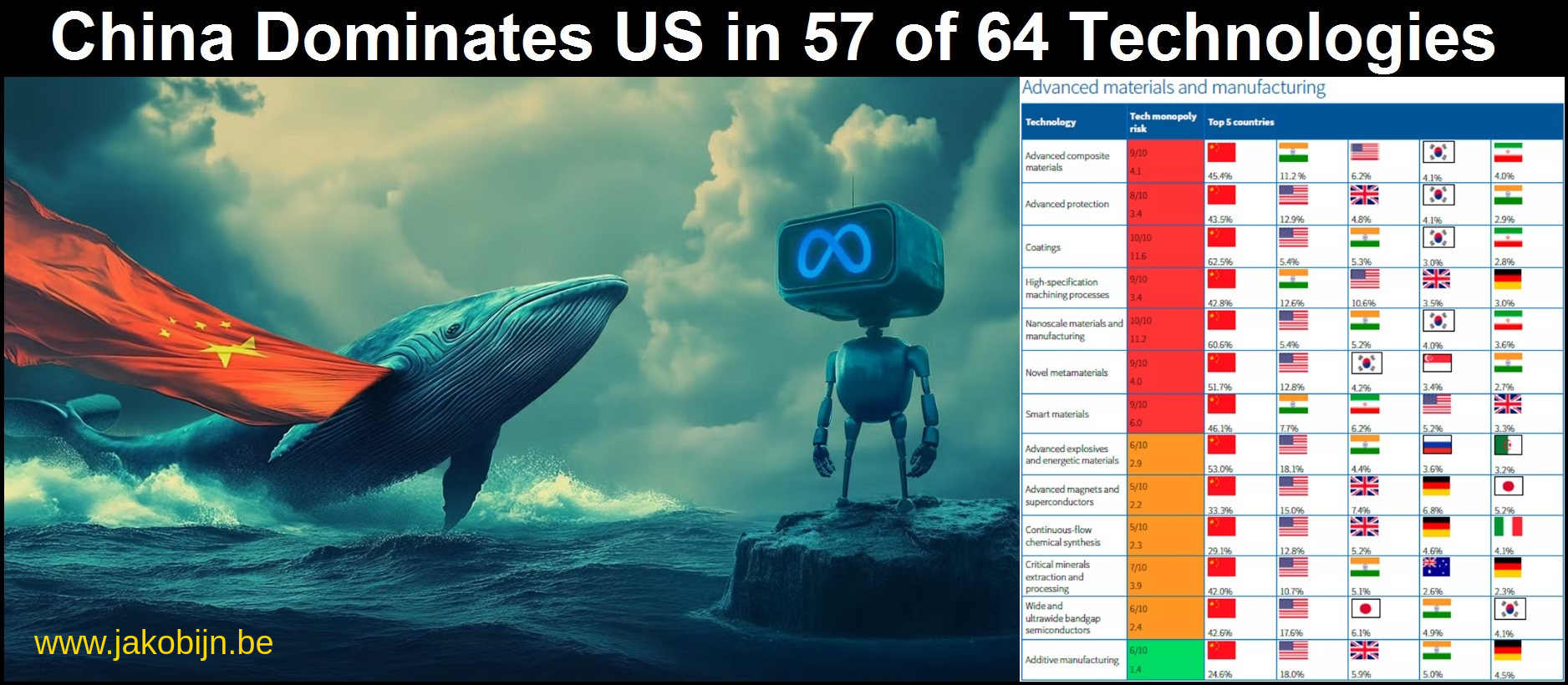
During 2003–2007 , the United States ranked first in 60 of the 64 technologies examined. China led in just three. For 2019–2023 , the figures had reversed: the US led in only seven technologies (including vaccines and some space technologies), while China led in 57 of the 64 critical technologies. These include artificial intelligence, quantum technology, advanced materials, biotechnology, energy storage, robotics and advanced shipbuilding.
This does not mean China commercially dominates every technology — ASPI primarily measures high-quality, highly cited research as an indicator of future scientific and technological capability. But the trend is unmistakable and irreversible. A country that combines an enormous industrial base, infrastructure, energy supply, scientific capability and population possesses a different kind of power from an economy in which an ever-growing share consists of financially valued services.
China's rise is not the result of chance or Western generosity. It is the result of decades of targeted, state-led industrial policy, investment in education and research, and a long-term vision unknown in the West. While Western governments are replaced every four years and their policies repeatedly reversed, China works on plans spanning ten, twenty and fifty years. That is the difference between a functioning state and a puppet regime.
7. 2011: The Turning Point in Relations with China
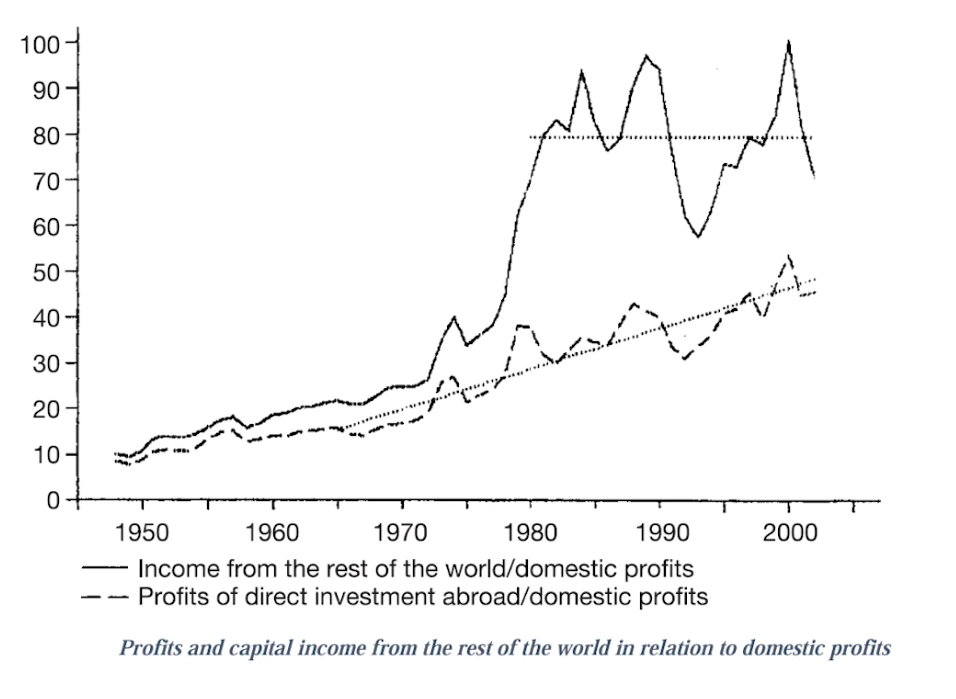
This image accompanying the article perhaps illustrates the most important geopolitical shift of the twenty-first century. The chart shows two opposing trends: China's holdings of US Treasury securities are declining while China's official gold reserves are increasing. According to the chart, Treasury holdings stand at approximately $682.6 billion and gold reserves have risen to around 74.1 million troy ounces.
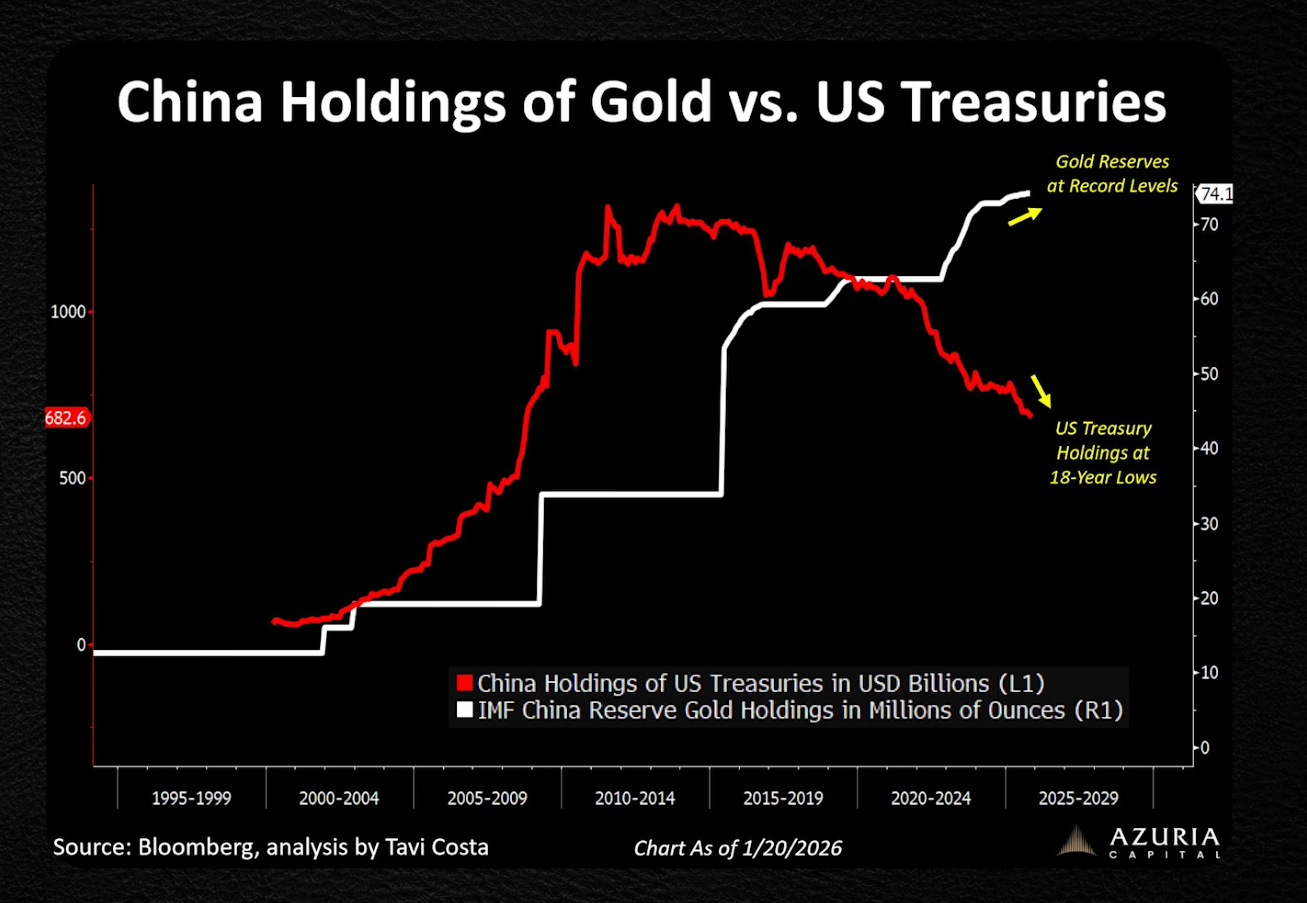
According to Lama, 2011 was the crucial turning point. Until 2011, China followed the unwritten rules of the Western financial system: it exported goods to the West, earned dollars and parked a large share of those dollars in US Treasury bonds at the Federal Reserve in New York. This kept the system in balance — China supplied goods, the West supplied money, and the money was parked in Treasury bonds so that it would not flow back into the goods market and cause inflation.
In 2011, however, China stopped systematically buying Treasury bonds. At the same time, it began systematically buying gold. This was the moment China changed from a "partner" in the Western system into a strategic competitor. Obama's 2011 "pivot to Asia" was the Western response to this shift — but it was too late. China had already decided it would no longer be the producer of goods that parked its surpluses in its competitor's financial system.
The precise monthly figures must always be checked against official statistics, but the long-term direction is correct. China has significantly reduced its holdings of US Treasury securities from a peak of more than one trillion dollars, while expanding its official gold reserves. According to the World Gold Council , the People's Bank of China reported another eight tonnes of gold purchases in April 2026. That brought official holdings to approximately 2,322 tonnes, around nine percent of China's official reserves. It was the eighteenth consecutive month in which the PBoC reported a purchase.
This does not prove that China will abandon the dollar tomorrow. It does represent a clear form of diversification. And gold has one geopolitically important characteristic that a foreign government bond does not: physical gold held in one's own custody is not a claim on a foreign counterparty. A US Treasury security is ultimately an obligation of the American state — an obligation that can be frozen, confiscated or declared invalid. Physical gold is an asset without an external debtor. In a world where foreign-exchange reserves can be frozen (as happened to Russian reserves in 2022, including at Euroclear in Belgium), this distinction takes on growing geopolitical significance.
8. Iran: The Scientific and Energy Center of Gravity of the RIC Triangle — the Primakov Triangle
Iran is the most underestimated country in the world in Lama's analysis. Western media portray Iran as an isolated, backward theocratic regime on the brink of collapse. Reality is radically different. Iran is a country with an exceptional scientific, industrial and energy base that has survived decades of severe sanctions and emerged stronger.
 Iran is a global player in science and technology. According to the ASPI report, Iran ranks at the same level as Japan in critical technologies. For decades, Iran has ranked first worldwide in the growth of scientific output — faster than South Korea, faster than China, faster than any Western country. Iran has the highest proportion of women in science and technology in the world — a fact that completely undermines the Western narrative of "oppression of women" in Iran. True emancipation of women does not mean that they can wear bikinis on the beach — it means they can develop their abilities to the fullest. And Iranian women are doing just that.
In energy terms, Iran is a superpower. According to the US Energy Information Administration (EIA), Iran possesses the world's second-largest oil and gas reserves (the largest when oil and gas are combined). Oil reserves alone represent around twelve percent of the world's total. Iran produces more than enough energy for domestic use and is a major exporter. In 2024, Iran consumed approximately 13.96 quadrillion Btu of primary energy and produced approximately 20.18 quadrillion Btu.
Militarily, Iran has built impressive autonomy. It manufactures its own missiles, drones, air-defense systems and naval weapons. The "Axis of Resistance" — Iran's network of allies and partners in Lebanon, Syria, Iraq, Yemen and Palestine — has become one of the world's most effective military alliances, as demonstrated by confrontations with Israel and the US in 2024 and 2025. Iran has shown that it can withstand the US and Israel without a single ally intervening directly with military force.
Geopolitically, Iran is indispensable to both Russia and China. For China, Iran is a reliable energy partner that cannot be cut off by Western sanctions or blockades. For Russia, a sovereign Iran is essential to the stability of its southern periphery — without Iran, Islamist extremists from the Middle East could destabilize the Caucasus and Central Asia, as happened in Chechnya and Dagestan. Iran is the stabilizer of Eurasia.
9. Russia: The Invincible Military and Raw-Materials Power
Russia is the country the West fears most — and not without reason. Russia has the largest land area in the world, the largest reserves of natural resources, and the most advanced military technology. No country in the world can defeat Russia militarily — as the war in Ukraine has now clearly demonstrated.
For years, Western media claimed that Russia would collapse economically under sanctions, that its army would be exhausted, and that Putin would be overthrown. None of this has happened. Russia has successfully reoriented its economy toward Asia, increased its military production to a level the West cannot match, and strengthened its global position. Russia is now China’s principal energy partner, a key player in the BRICS alliance, and an indispensable ally of Iran.
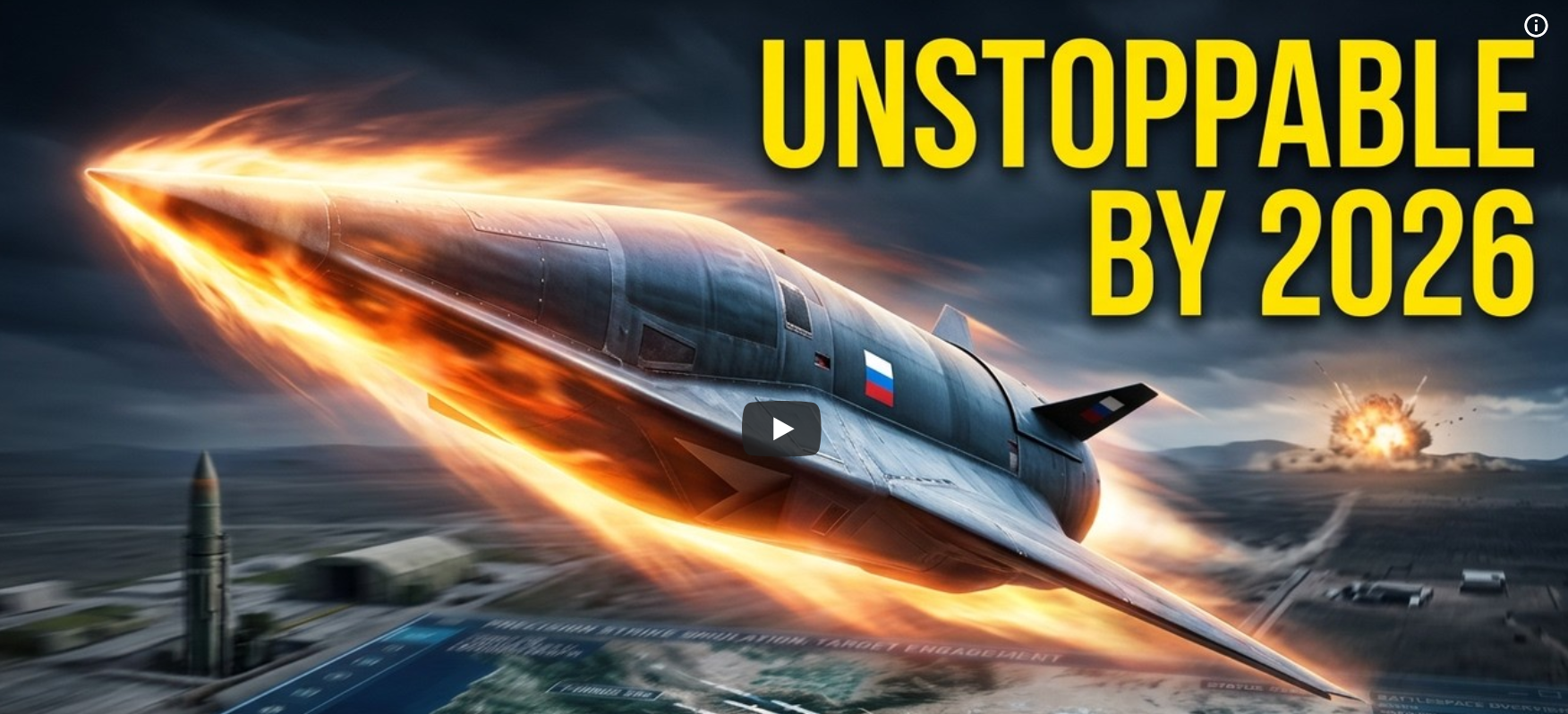
Click on the image to watch the video
In military affairs, Russia is unrivaled in strategic weapons. The hypersonic missiles Kinzhal, Zircon and Avangard cannot be intercepted by any Western air-defense system. The S-400 and S-500 air-defense systems are among the most advanced in the world. Russia possesses the world’s largest nuclear arsenal, and its nuclear doctrine is clear: any attack on Russian territory may be answered with nuclear weapons. This makes Russia untouchable.
In terms of natural resources, Russia is equally indispensable. Russia is the world’s largest exporter of natural gas, one of the largest exporters of oil, the largest producer of nickel and palladium (essential to the automotive and electronics industries), a major producer of titanium (essential to the aviation industry), and one of the largest exporters of grain and fertilizers. Without Russian raw materials, Western industry would come to a complete halt within a few months.
The West’s attempt to isolate Russia through sanctions has therefore failed completely. Instead, the West has isolated itself. Europe has lost its cheap Russian energy, its industries are relocating to the United States and Asia, and its standard of living is declining. Russia, by contrast, has found new markets in Asia, the Middle East and Africa, and its economy is growing faster than those of the G7 countries combined.
10. The Financial System as an Instrument of Power — and Why It Is Failing
American power after 1945 rested on four pillars: economic and industrial superiority; military superiority; control over the international financial system; and control over information and perception (mass psychology). According to Lama, the first two pillars have been severely weakened. China overtook the United States economically around 2011 and the G7 around 2020. Russia and Iran have demonstrated that Western military superiority is a myth. That is why the third pillar — financial power — is more important than ever.
But this pillar, too, is crumbling. The US dollar is used less and less in international transactions. The BRICS countries are developing alternative payment systems. Central banks around the world are buying gold in record quantities. Bilateral trade in local currencies is increasing. The dollar remains the leading reserve currency — approximately 40% of global reserves and 70% of international trade — but the trend is clear: the dollar is losing ground.
This is not a revolution that happens overnight. It is erosion. Historically, imperial systems do not usually disappear on the day a competitor declares them finished. They disappear when more and more actors discover that they can function without the system. And that is precisely what the RIC countries are discovering now.
11. The War in Ukraine as a Catalyst for the Multipolar World
The war in Ukraine has been presented by the West as a struggle between democracy and authoritarianism. In reality, it is a proxy war in which the West has tried to weaken Russia, break it apart, and bring its natural resources under Western control. That plan has failed completely.
Russia has not merely held out — it has emerged stronger from the conflict. Russia has increased its military production, reoriented its economy toward Asia, and strengthened its global position. Ukraine, meanwhile, has been devastated, its population is fleeing en masse, and its territory is slowly but surely coming under Russian control. NATO has not grown stronger — Finland and Sweden have joined, but NATO has demonstrated that it cannot defeat Russia militarily without entering the war directly.
The war in Ukraine has also shown that Western military superiority is a myth. The West ran through its artillery shells within months, while Russia continued producing them. Western sanctions against Russia have not worked — Russia has found new trading partners and its economy has grown. Western media claimed for years that Russia would collapse — none of this has happened.
The war in Ukraine has thus been a catalyst for the multipolar world. It has shown that the West can no longer dominate the world, that its military power is limited, that its economic sanctions do not work, and that its media no longer tell the truth. It has also shown that Russia, China and Iran together are stronger than the West — and that the future of the world is not decided in Washington or Brussels , but in Moscow, Beijing and Tehran.
12. The Inevitable Decline of the Financial Empire
Lama’s analysis leads to an inevitable conclusion: the West’s financial empire is doomed . This is not a prediction — it is an observation of what is already happening. The four pillars of Western power are crumbling one by one:
- Economic superiority: China overtook the United States in real economic power (measured by energy consumption) around 2011, and the G7 around 2020. Western industry is moving to Asia. Western living standards are declining.
- Military superiority: Russia and Iran have shown that the West is unable to defeat sovereign countries militarily. The war in Ukraine and confrontations in the Middle East have demonstrated this beyond doubt.
- Financial superiority: The dollar is losing ground as a reserve currency. BRICS is developing alternative payment systems. Central banks are buying gold in record quantities. Western sanctions have shown that the financial system can be weaponized — and that other countries therefore seek alternatives.
- Control over perception: Western media are losing credibility. More and more people are discovering that narratives about “democracy versus authoritarianism,” “Russian collapse,” and “Iranian isolation” do not correspond to reality. Social media platforms such as X, Telegram and alternative news sources are breaking the Western media monopoly.
The empire’s decline is not a sudden collapse — it is a gradual erosion. But the direction is irreversible. The RIC countries are building an alternative system that does not depend on the dollar, the IMF, the World Bank or Western media. This system is based on material production, energy, raw materials and mutual cooperation. And this system is stronger than the West’s financial empire.
13. Why the Struggle over Iran Is Much Bigger than Iran
In Lama’s theory, Iran takes on almost existential importance. Not because Iranian GDP is impressive — by Western measures, it is not. Rather, Iran stands precisely at the intersection of energy, geography, military autonomy and alternative Eurasian integration. EIA figures show how exceptional its energy position is. If such a state were fully integrated into a Washington-led financial and security system, this would considerably increase American influence over Eurasian energy supplies.
If, on the other hand, Iran continues to cooperate closely with China and Russia, a largely continental economic space emerges in which industry, raw materials, energy and transport corridors can complement one another without every transaction necessarily passing through Western institutions. That is why the confrontation with Iran is at least as important economically as it is militarily.
Iran is also the key to the liberation of the Arabian Peninsula. The states of the Arabian Peninsula — Saudi Arabia, the UAE, Qatar, Bahrain, Kuwait and Oman — were created in the twentieth century by British and American colonial powers. They are vassal states, not sovereign nations. If Iran remains strong, the Arabian Peninsula will ultimately be freed from Western control. And when that happens, the world’s largest energy source will fall outside Western control. That is the empire’s nightmare.
14. The Role of Western Media: Fake News as a Weapon
An essential part of Lama’s analysis concerns the role of Western media. Mainstream Western outlets — CNN, BBC, the New York Times, the Washington Post, Der Spiegel and Le Monde — are not independent news organizations. They are instruments of the state and big capital, designed to sustain the empire’s narrative.
Western media claimed for years that Russia would collapse under sanctions — it did not. They claimed that the Russian army would be exhausted in Ukraine — it was not. They claimed that Iran was economically isolated — that is untrue. They claimed that China’s economy would collapse — it did not. They claimed that the BRICS countries could offer no alternative to the Western financial system — they are now building one.
 Western media are “fake” in the most literal sense of the word. They present a reality that does not exist. They use GDP figures that conceal real economic power. They portray wars as “democracy versus authoritarianism” when in reality they are about raw materials and geopolitical control. They portray sanctions as “instruments of peace” when in reality they are economic warfare.
The RIC countries have understood this. China has its own social media platforms and news organizations. Russia has RT, Sputnik and other alternative media. Iran has Press TV, Al-Alam and other English-language media. All are censored by the EU. These outlets are not perfect — no media outlet is — but they offer an alternative to the Western media monopoly. And that is essential to building a multipolar world.
15. The New Measure of Power: From Financial to Material
The most important conclusion from the interview with Fadi Lama is his challenge to the way we measure the world. Anyone who looks at the world exclusively through financial indicators sees a United States worth tens of trillions of dollars confronting an Iran worth only a few hundred billion.
- Anyone who looks at energy sees something different.
- Anyone who looks at oil and gas reserves sees something different.
- Anyone who examines steel, shipbuilding and manufacturing sees something different again.
- Anyone who examines scientific research in critical technologies discovers that, according to ASPI, China now leads in 57 of the 64 fields studied.
- Anyone who follows gold reserves and US Treasury securities sees China reorganizing its financial exposure.
- None of these indicators tells the whole truth on its own.
- Together, however, they tell a story that is barely visible in conventional nominal GDP.
The RIC countries understand this. They measure their power not in dollars, but in tonnes of steel, kilowatt-hours of electricity, barrels of oil, numbers of missiles produced, numbers of engineering graduates, and kilometers of railway built. And by all these measures, they are the world’s leaders.
16. From a Financial to a Material World Order
This, ultimately, is the historic transformation we are witnessing. For several decades after the end of the Cold War, it seemed that financial power could be converted almost without limit into geopolitical power. Capital could move anywhere. Production could be outsourced. Raw materials could be purchased on world markets. International transactions were largely conducted through financial infrastructure dominated by the West. The US dollar served as the central reserve and transaction currency. Under such circumstances, it may have seemed rational, from a purely financial perspective, to relocate factories abroad and concentrate instead on financial, legal, digital and other high-value services. But geopolitical confrontation changes that logic.
Suddenly, it matters again who produces energy. Who makes steel. Who builds ships. Who has enough electricity. Who manufactures machine tools. Who can supply fertilizers. Who can produce their own weapons. Who can keep payments flowing when a foreign government imposes sanctions. And who can continue feeding their population when international trade routes are disrupted. This is not a return to the nineteenth century. It is the rediscovery of a truth easily forgotten during the era of financial globalization: money is a claim on the material world. It is not the material world itself.
The RIC countries have never forgotten this truth. Russia has always invested in its military-industrial complex, energy infrastructure and raw-material production. Iran has always invested in its scientific capabilities, defense industry and energy production — despite decades of sanctions. China has always invested in its industrial base, infrastructure, technological capacity and energy supply. They have not deluded themselves into thinking that financial power is sufficient — they have built material power.
Conclusion: The RIC Countries as Architects of the Multipolar World
Fadi Lama deliberately frames his argument provocatively. His assertion that virtually all economic statistics are “rubbish” is a necessary correction to the Western obsession with GDP figures. His definition of the Federal Reserve as a private enterprise is correct in simplified form — real power lies with private banking, not the US government. His energy index cannot simply replace GDP — but it is a much better indicator of material economic power.
Yet when this nuance is added, an especially important core remains. Economic power consists of more than money. Sovereignty consists of more than a flag. Military power consists of more than defense budgets. And geopolitical power consists of more than the number of aircraft carriers. The great transformation of our time is that countries are once again trying to connect financial power with material power.
China is doing this by combining industry, infrastructure, technology, energy supply and financial diversification. Despite its much smaller nominal economy, Russia possesses exceptional quantities of energy, natural resources, agricultural land and military capacity. Despite decades of sanctions, Iran has developed a degree of industrial, scientific, energy and military autonomy that is difficult to reconcile with its portrayal as an economically insignificant state.
At the same time, the West still possesses enormous assets. The outcome is therefore not predetermined. The decisive question of the coming decades will not be who has the highest GDP on paper. The question will be: who can produce what they need, who possesses the energy to produce it, who masters the technology, who controls the payment channels — and who can keep functioning when the other side says “no”?
That is the real meaning of sovereignty. And that is precisely why Iran, Russia and especially China matter more than their position in traditional Western economic rankings suggests. The shift toward a multipolar world need not mean that the dollar disappears tomorrow, the United States collapses, or Europe ceases to be an economic power. It means something more fundamental.
For the first time since the end of the Cold War, major economic centers are emerging with enough industry, energy, raw materials, technology and political autonomy to attempt to operate outside a system organized exclusively by the West. If that process succeeds, the most important change will not be that Washington is replaced by Beijing, Moscow or Tehran as the new ruler of the world. It will be that no single center of power can any longer dictate the terms for the entire world. And perhaps that, far more than all the rhetoric about East versus West, is the true meaning of the multipolar world.
The RIC countries are not enemies of the West: they are the architects of a world in which no country can dominate the globe. And that, ultimately, is the only foundation for a just international order.
Sources and References
- Interview with Dr. Fadi Lama on The Cradle: https://youtu.be/x4M_57JNh1o
- Fadi Lama, “The West’s Plan B: Secure the Realm,” The Cradle, 2022: https://thecradle.co/
- Fadi Lama, Why the West Can't Win: From Bretton Woods to a Multipolar World
- Australian Strategic Policy Institute, “ASPI’s Two-Decade Critical Technology Tracker”: https://www.aspi.org.au/report/aspis-two-decade-critical-technology-tracker/
- World Gold Council, “China Gold Market Update”: https://www.gold.org/goldhub/gold-focus/2026/05/china-gold-market-update-notable-rise-gold-reserves
- U.S. Energy Information Administration, Iran country profile: https://www.eia.gov/international/overview/country/IRN
- Energy Institute, Statistical Review of World Energy 2024: https://energyinst.org/statistical-review/insights-by-source
- World Bank Open Data: https://data.worldbank.org/
- United Nations Charter: https://www.un.org/en/about-us/un-charter/full-text
- Federal Reserve, “Who owns the Federal Reserve?”: https://www.federalreserve.gov/faqs/about_14986.htm