
How American Overconfidence and Geopolitical Blindness Are Plunging the Middle East and Eastern Europe into the Abyss
By Frank Dumon
The Myth of the Invincible Hegemon
The contemporary geopolitical architecture, long dominated by a unipolar American hegemony, is showing cracks that can no longer be ignored or glossed over by Western mainstream media. What we are currently witnessing is not a series of isolated diplomatic missteps, but a systematic, deeply rooted collapse of Washington's strategic logic. From the war of attrition in Eastern Europe to the logistical and moral quagmires in the Middle East, the American empire is repeating the mistakes of the past, blind to the reality on the ground.
This analysis, based on the sharp observations of former American Judge Andrew Napolitano and the detailed military insights of whistleblower and former Special Forces officer Anthony Aguilar, reveals an inexorable truth: the United States is not only being militarily challenged, it is being actively baited and slowly bled dry by a combination of its own hubris, logistical impotence, and an enemy that has time on its side.
The title of this analysis is no coincidence. It echoes the core of a deeper historical awareness: the price of the illusion that military superiority alone suffices to bend complex geopolitical realities. Just as in Vietnam, and later in Afghanistan and Iraq, Washington believes that technological superiority and financial depth can compensate for any strategic shortcoming. Reality, however, is more stubborn. As the available transcripts and analyses irrefutably demonstrate, the American strategy in both Ukraine and Iran is based on wishful thinking, fueled by a donor class that has hijacked foreign policy, and executed by a military apparatus that has reached its own logistical limits.
The Eastern Front: Napolitano on Putin, NATO, and the War in Ukraine
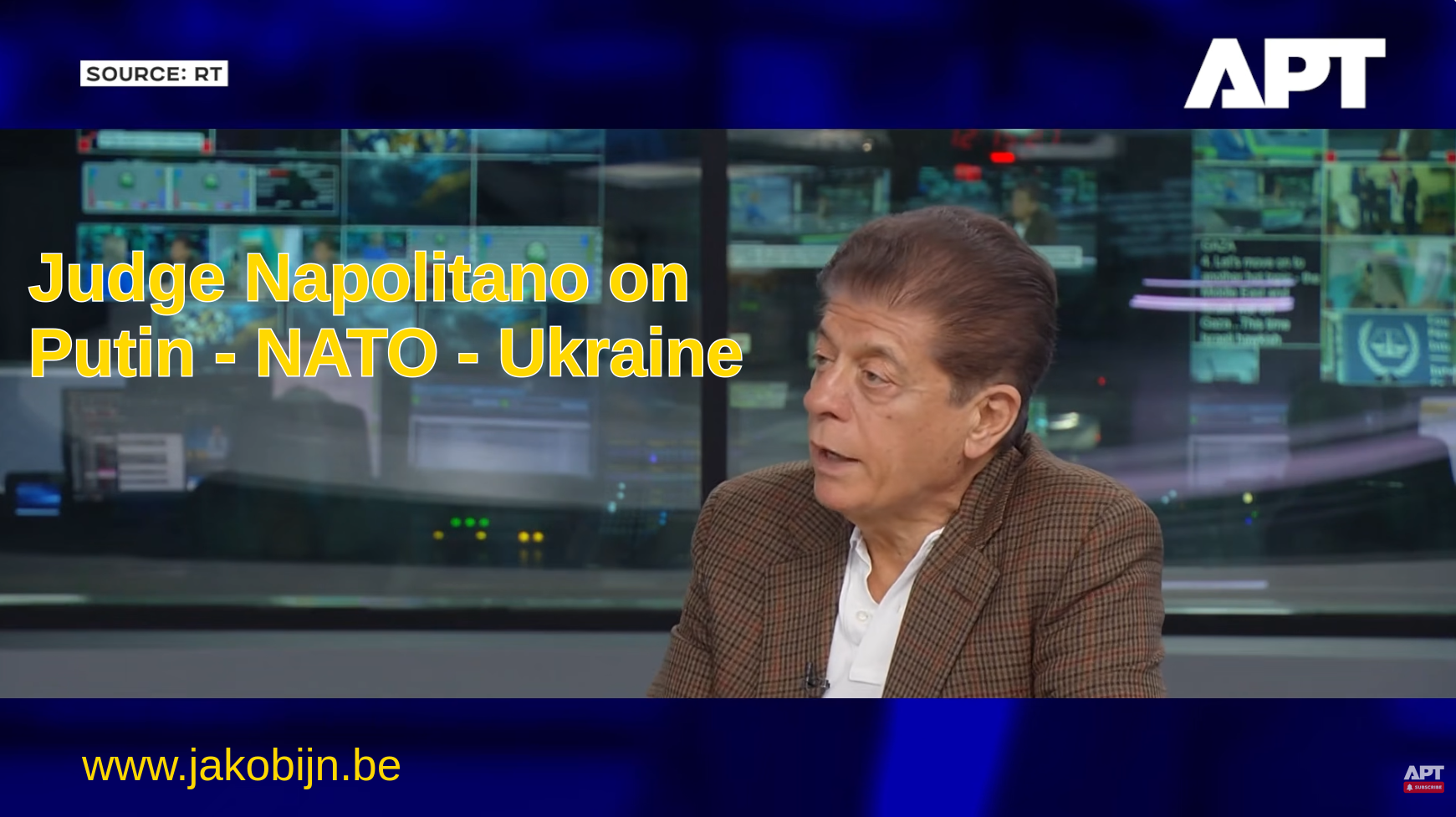
To understand the current American strategic blindness, we must first look to the Eastern Front. Former New Jersey Supreme Court Judge Andrew Napolitano paints a devastating picture in his podcast 'Judging Freedom' of the Western approach to the war in Ukraine. According to Napolitano, Ukrainian leaders are painfully aware that they are on their "last legs." The days of the regime are numbered, yet they continue with reckless actions, such as recent threats against commercial airports in Moscow. Napolitano emphasizes that merely threatening civilians constitutes a war crime under international law, a nuance consistently ignored in Western media.
Western media, particularly in the United States and the United Kingdom, remain in lockstep with their respective governments. They do not act as watchdogs of democracy but as propaganda channels that must sell a failing neoconservative policy to a public that would otherwise rebel. Napolitano subtly points out that Ukraine is probably the most corrupt country on the planet, a fact that remains invisible to the average viewer in New York or London behind a wall of media silence. This corruption is not merely a domestic affair; it is the reason why Western tax money disappears into a bottomless pit.
The escalation by NATO countries, such as the discussions between France and the UK about producing long-range Scalp missiles directly on Ukrainian territory, and the transfer of classified blueprints to Kiev, is a desperate attempt to postpone the inevitable. Russian military objectives – destroying the Ukrainian government so that NATO can never establish a foothold, and liberating the Russian-speaking population in the east – are being steadily realized. Napolitano raises a crucial legal and strategic point: President Putin has shown a "near sacred" capacity for patience. He does not want a war with NATO. However, under international law, Russia has every right to strike ammunition factories and military installations in NATO countries that produce weapons fired deep into Russian territory. Even if civilians work in those factories, they remain a legitimate military target. That Putin has not exercised this right to date is a sign of strategic restraint, not weakness. But this restraint has its limits, and the continued "poking of the bear" by European capitals is a dangerous game that may one day provoke a proportionate and devastating reaction.
In this context, it is telling to refer to the video above. These meetings, away from hysterical public rhetoric, indicate a behind-the-scenes recognition that the war must be concluded through diplomatic channels, and that the current Ukrainian leadership is an obstacle to this. It is a tacit confirmation that the reality on the battlefield has overtaken the narratives in Washington and Brussels.
The Middle East: The Genocide in Gaza and Israel's Grip on Washington
The same geopolitical blindness that prolongs the war in Ukraine drives the catastrophe in the Middle East. Napolitano spares no words in his condemnation of Israeli actions in Gaza, which he qualifies as a "long-term, obvious genocide." Minister Ben-Gvir's proposal for "voluntary migration" of Palestinians – a euphemism for ethnic cleansing – fits a pattern of fanaticism aimed at provoking the Palestinian population into a violent reaction, subsequently using it as an excuse for further destruction.
The most disturbing aspect of this situation is not Israeli policy per se, but the unconditional, blind support of the United States. Napolitano puts his finger on the sore spot: the U.S. federal government is profoundly influenced by the Israeli government, and the mechanism of this influence is the donor class. Of the 535 members of the U.S. Congress, 350 have had their campaigns funded by the American Israel Public Affairs Committee (AIPAC). This is a mix of foreign and domestic money that systematically undermines the democratic will of the American people. While polls repeatedly show that an overwhelming majority of Americans are against sending more money to the Netanyahu regime, Congress unanimously votes for further funding.
Netanyahu has openly boasted about his decades-long efforts to control the U.S. government, and he has succeeded. This control now extends to U.S. foreign policy, dragging Washington into a conflict that is not in its own strategic interest, but serves to realize the vision of a "Greater Israel" from the river to the sea. Suggestions from former Israeli leaders to even attack Turkey – a country with the second largest army in the region – demonstrate how far Israeli strategic madness has progressed, shielded by an American security umbrella that itself is crumbling.
The Iranian Trap: How Tehran Is Luring the US into the Abyss
Here we reach the core of the current strategic crisis, perfectly analyzed by retired Lieutenant Colonel Anthony Aguilar, a Special Forces veteran with 25 years of combat experience and a whistleblower on misconduct in humanitarian operations. His analysis of the confrontation between the United States and Iran is sobering and supports the thesis that "Iran has baited the US and is bleeding it dry."
According to Aguilar, the fundamental mistake of the United States is that this war was started without a clear political or military goal. There was no defined endgame, no negotiation strategy, and no realistic plan for the day after victory. The war was initiated under the neoconservative delusion that it would be a swift, overwhelming victory, a "shock and awe" that would make the world cheer. But as the history of Vietnam and Afghanistan teaches, a military apparatus, however advanced, is doomed to fail if it practices "bombing policy out of the desert": using military force as a substitute for a coherent policy.
Iran has cleverly exploited this American failure. Tehran does not possess fifth-generation fighter jets or a blue-water navy that can rival the U.S. Seventh Fleet. What Iran does have is geography, time, and a masterful understanding of asymmetrical warfare. Iran has shifted the battle to a terrain where American technological advantages are neutralized by the mathematics of attrition. Aguilar points to the devastating calculus: the United States fires interceptors costing millions of dollars each (like Patriot or THAAD systems) to shoot down drones that Iran mass-produces for as little as $1,000 to $30,000, often with 3D-printed parts. This asymmetrical war of attrition is rapidly depleting American stockpiles of strategic interceptors and precision munitions, while Iran can easily scale up its production, also thanks to technological cooperation with Russia and China.
Logistical Nightmares and the Illusion of 'Decisive Victory'
The logistical reality of this war is a nightmare that was initially underestimated by U.S. military planners. Aguilar emphasizes that the United States can no longer operate from its traditional forward bases in the region. The Fifth Fleet in Bahrain and CENTCOM headquarters at Al Udeid, Qatar, have become vulnerable to Iranian missile attacks. As a result, the U.S. must now rely on a second and third ring of logistical support, far away in the Indian Ocean (Diego Garcia) or even in Southeast Asia (Singapore).
These extended supply lines are extremely vulnerable. An aircraft carrier and its escort fleet consume enormous amounts of fuel and supplies. The Strait of Hormuz and Bab el-Mandeb, crucial chokepoints for global energy supply, are effectively controlled or disrupted by Iranian and Houthi actions. This has direct consequences for the U.S. domestic economy, as Napolitano also noted: rising diesel and gasoline prices are a direct result of this military adventurism, and the administration completely failed to foresee the economic impact of a military escalation in the Gulf.
Aguilar states that the United States, in its current operational format, can only sustain itself for about another 90 days before logistical and ammunition stocks reach critical levels. This creates an existential compulsion for the White House. Because there is no clear victory, and because resources are running out, the "albatross of decisive victory" begins to weigh heavily. When a nation does not know what victory looks like, any arbitrary, radical means begins to seem like one. This explains the increasingly loud rhetoric about possible escalations, including limited ground invasions of islands in the Strait of Hormuz (such as Larak and Qeshm) or, even more worryingly, the deployment of tactical nuclear weapons (like the B61-12) to destroy Iranian nuclear facilities and thus claim a "victory" before the elections or logistical collapse make it impossible.
Escalation Danger and Iran's Strategy of 'Throwing Out Bait'
One of the most fascinating aspects of Aguilar's analysis is the observation that Iran is actively "baiting" the United States. For instance, Iran has moved outdated mines and missile systems from Qeshm to Larak. This is not accidental military repositioning; it is a strategic trap. Iran knows that the United States is forced to respond to these threats to maintain its credibility. By being able to strike these targets, Iran forces the U.S. Navy to move closer to the coast, away from the safety of the deep Indian Ocean, and closer to the kill zone of Iranian anti-ship missiles and drones.
When a U.S. ship is damaged far out in the ocean, the Pentagon spokesperson can dismiss it as a "fire in the laundry room," as Aguilar sardonically notes about previous incidents. But if a ship is hit while operating close to the coast to strike an Iranian target, such denial becomes impossible. Such an attack would mean massive American casualties and would definitively turn U.S. public opinion against the war. Iran is counting on this. Tehran is in no hurry. They know that time works in their favor, that American resources are limited, and that every escalation only increases the political costs for the incumbent U.S. administration.
Moreover, Iran is not alone. Geopolitical shifts in the region are in Tehran's favor. Emerging defense alliances between countries like Saudi Arabia, Pakistan, and Turkey, with the possible accession of Iran, are rewriting the security architecture of the Middle East. The United States, which saw itself as the indispensable protector of regional security, is increasingly becoming the "outcast," isolated by its own aggressive policies. The petrodollar, the foundation of American economic hegemony, is being undermined as regional actors settle their trade in other currencies to circumvent U.S. sanctions.
The Role of Russia and China: A New World Order in the Making
The American overstretch in the Middle East does not go unnoticed by the other major powers. For Russia, a prolonged, exhausting war between the United States and Iran is a strategic gift. It ties up American resources, attention, and crucially, advanced munitions (like ATACMS missiles) in the Middle East, preventing them from being sent to Ukraine. Russia has every interest in continuing to provide Iran with intelligence, satellite data, and defense technology, because a strong Iran keeps NATO and the US busy on a second front.
China, which is Iran's largest trading partner, has similar interests. U.S. attempts to economically strangle Iran are seen in Beijing as a test balloon for how the U.S. ultimately intends to contain China itself. China will not passively watch a crucial node in the Belt and Road Initiative be destroyed. Although direct military intervention with "boots on the ground" is unlikely, China will increase its support for Iran through advanced weapons systems (like J-35 fighter jets that could be funneled via Pakistan), maritime presence, and economic lifelines.
The U.S. strategy of "maximum pressure" and sanctions has failed. Instead of bringing down the Iranian regime, it has forced the country to become self-sufficient, build its own drone industry, and forge closer ties with the emerging multipolar order. The United States is trying to turn back the clock to a unipolar world that no longer exists, and is paying a bloody price for it.
Conclusion: The Inevitable Collapse of the Empire
The analyses of Andrew Napolitano and Anthony Aguilar paint a somber but irrefutable picture of a superpower shooting itself in the foot. The United States is not being defeated in the Middle East by superior military force, but by its own strategic blindness, logistical arrogance, and the mathematical reality of asymmetric attrition. Iran has trapped the US by changing the rules of war, away from conventional battles towards a slow, deadly bleeding of resources and political will.

The EU, now as a lackey of America, has also issued a series of sanctions against Iran. That is all our bewildered "leaders" can still do. In doing so, they forget that Iran has completely reduced its trade with Europe in favor of Russia and China to barely 1.5%. They do not need Europe at all. But Europe does need Iran and the free passage of goods, such as oil - diesel - gas - fertilizers - helium - aluminum, etc., through the Strait of Hormuz.
At the same time, the neoconservative elite in Washington continues to fuel conflicts, from Ukraine to Gaza, driven by a combination of ideological dogmas and the financial interests of the defense industry and foreign lobby groups. As Napolitano aptly notes, there is no morality left in American foreign policy, only the whims of the moment and the protection of geopolitical clients.
For observers who have studied history, this is a familiar pattern. It is the price of the illusion. The illusion that might creates justice, that technology can substitute for strategy, and that a nation can endlessly continue to draw on its own resources to finance distant, incomprehensible conflicts. The United States is on the verge of inheriting the legacy of Vietnam and Afghanistan in the heart of the Middle East: a prolonged, senseless conflict that hollows out the nation from within, while the rest of the world, from Moscow to Beijing and Tehran, quietly organizes itself for the day the American flag is finally lowered. The question is not whether this collapse will occur, but how much damage it will cause before the inevitable retreat begins.