
No Room for Western Diktat
Putin Links BRICS Expansion to Europe’s Systemic Crisis
By Frank Dumon
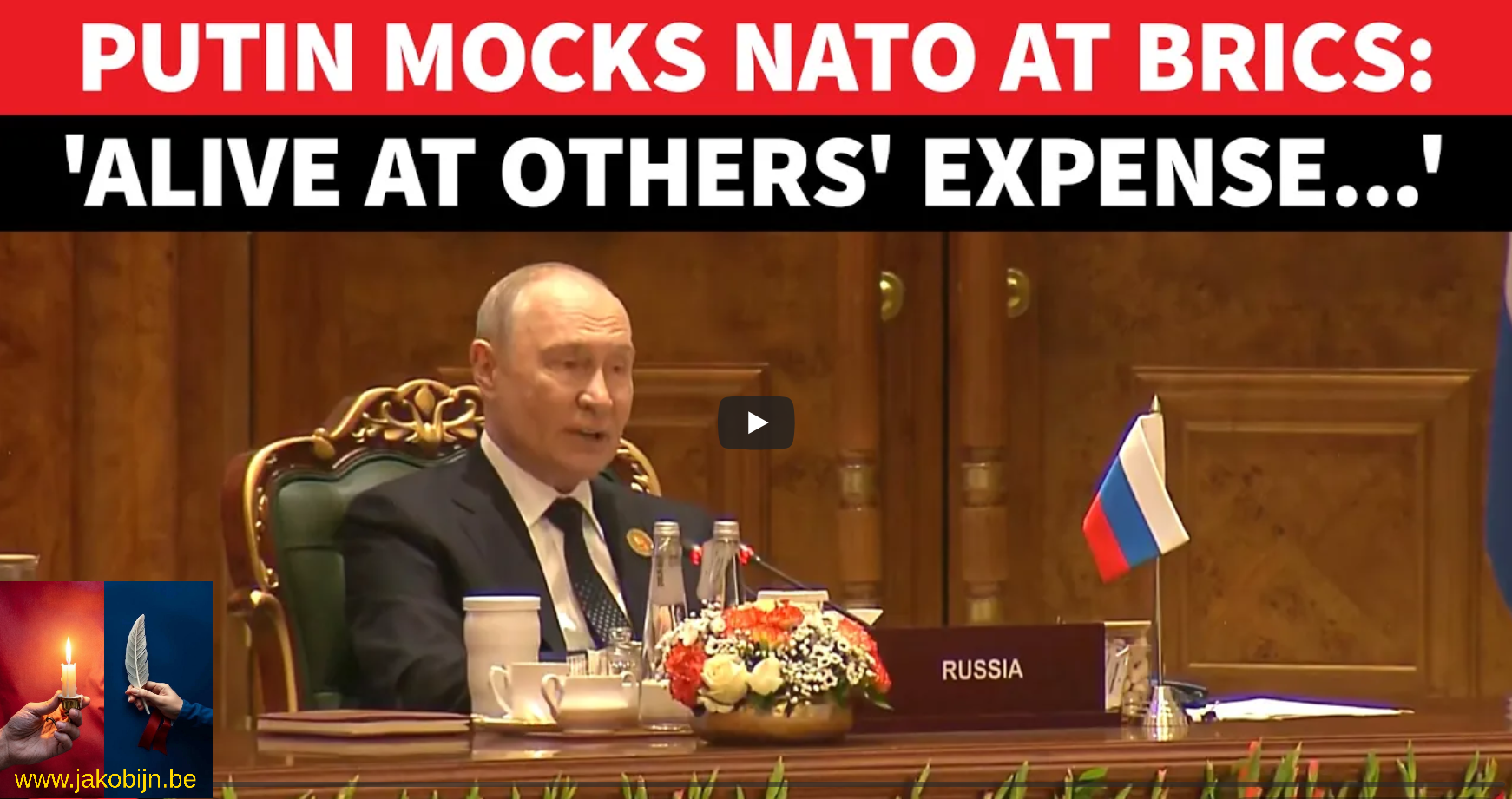
New Delhi, September 2026 – Addressing fellow leaders at the BRICS summit in New Delhi, Russian President Vladimir Putin delivered a sweeping assessment of the current geopolitical order, declaring that the era of unipolar dominance is definitively over. In remarks that connected the rise of the Global South with deepening political fractures within Europe, Putin argued that Western attempts to maintain hegemony through “colonial” thinking are not only failing globally but are actively destabilizing Western societies themselves.
Speaking to an audience representing nearly half the world’s population and 40% of global GDP, Putin characterized the transition toward multipolarity as inevitable yet fiercely contested. He accused established powers of resisting this shift through “tariff wars, illegitimate sanctions, economic dictate, blackmail, interference in internal affairs, and brute force.” According to the Russian president, these tactics stem from a mindset that divides the world into a “blooming garden” and “wild jungles,” allowing dominant nations to live at the expense of others while refusing to accept changing realities.
“The entire system of international relations is failing,” Putin warned, noting that old hotbeds of tension are being fanned and new conflicts provoked.
He emphasized that BRICS has become a key center of global governance precisely because it operates on principles of equality, good neighborliness, and respect for civilizational diversity—values he contrasted sharply with what he described as a rules-based order drawn up by “who knows whom.”
Building Alternative Infrastructure
Beyond critiquing existing institutions like the IMF and WTO, which he said struggle to adapt to shifting economic realities, Putin outlined concrete steps toward alternative infrastructure. These include a BRICS-based payment and settlement system, a new investment platform, a reinsurance mechanism, a grain exchange, and Russia’s participation in the newly established World Artificial Intelligence Cooperation Organization in Shanghai. He stressed that merely modernizing legacy institutions is insufficient; entirely new regulatory frameworks are required for breakthrough sectors like digital trade and fintech.
Crucially, Putin anchored this vision of institutional reform in the centrality of the United Nations Charter, calling for Security Council expansion to better represent Asia, Africa, and Latin America. “Genuine multilateralism” was presented not as anti-Western sentiment per se, but as a necessary correction to ensure universal prosperity and stability.
The European Backlash
The implications of this systemic critique were made starkly apparent during a subsequent press interaction, when Putin was asked about the recent electoral success of the Alternative for Germany (AfD) in Saxony and similar trends across Europe. While declining to comment directly on German domestic politics, he framed these developments as symptoms of profound strategic errors by Western elites.
“After the collapse of the Soviet Union, they felt atop Mount Olympus and believed anything was permitted to them,” Putin stated. He identified three compounding categories of error: security, energy policy, and historical amnesia. On security, he reiterated that NATO’s eastward expansion and regime change in Ukraine were root causes of the current conflict, arguing that Western support for separatism in the Caucasus and elsewhere had long preceded the crisis.
On energy, Putin pointed to Europe’s abandonment of stable, oil-indexed gas contracts in favor of exchange-based pricing as a self-inflicted wound driven by speculators rather than producers. “Gas is not a standard commodity,” he cautioned, noting that storage targets are now dictated by short-term profit motives rather than physical security, pushing prices to unsustainable levels.
A Betrayal of Kohl’s Legacy
Perhaps most pointedly, Putin invoked the legacy of former German Chancellor Helmuth Kohl, whom he knew personally. “He believed that the future of Europe could only be secured through close, allied relations with Russia,” Putin recalled. “Today’s political elites hold a very different view. They spook their populations with a fictitious Russian threat… But there is no such threat, and there never was.”
He warned that open discussions about deploying troops to Ukrainian territory amount to direct war with Russia—a prospect he believes European citizens increasingly recognize as the logical endpoint of current policies. “That, it seems to me, is precisely what underpins the recent election outcomes in the Federal Republic,” he concluded.
Taken together, Putin’s statements in New Delhi present a coherent narrative: the same hubris that drives resistance to multipolarity abroad is eroding democratic consensus and economic stability at home. As BRICS consolidates its role as an architect of alternative governance, the message to the West is clear—the choice is no longer between dominance and decline, but between adaptation and irrelevance. For Jakobijn’s readership, this underscores a pivotal moment where shifts in global power structures are no longer distant geopolitical abstractions but forces reshaping European politics from within.
Sources
- No Room For Western Diktat: Putin’s Shock BRICS Declaration Stuns NATO - https://youtu.be/sLkNBKzb_tA
- Putin on German Elections, War with Russia and Europe’s Energy Crisis - https://youtu.be/PyUG-N63V58