
From Printed Pages to a Living Digital Library: Why Publishing Books on a CMS Website Changes Everything
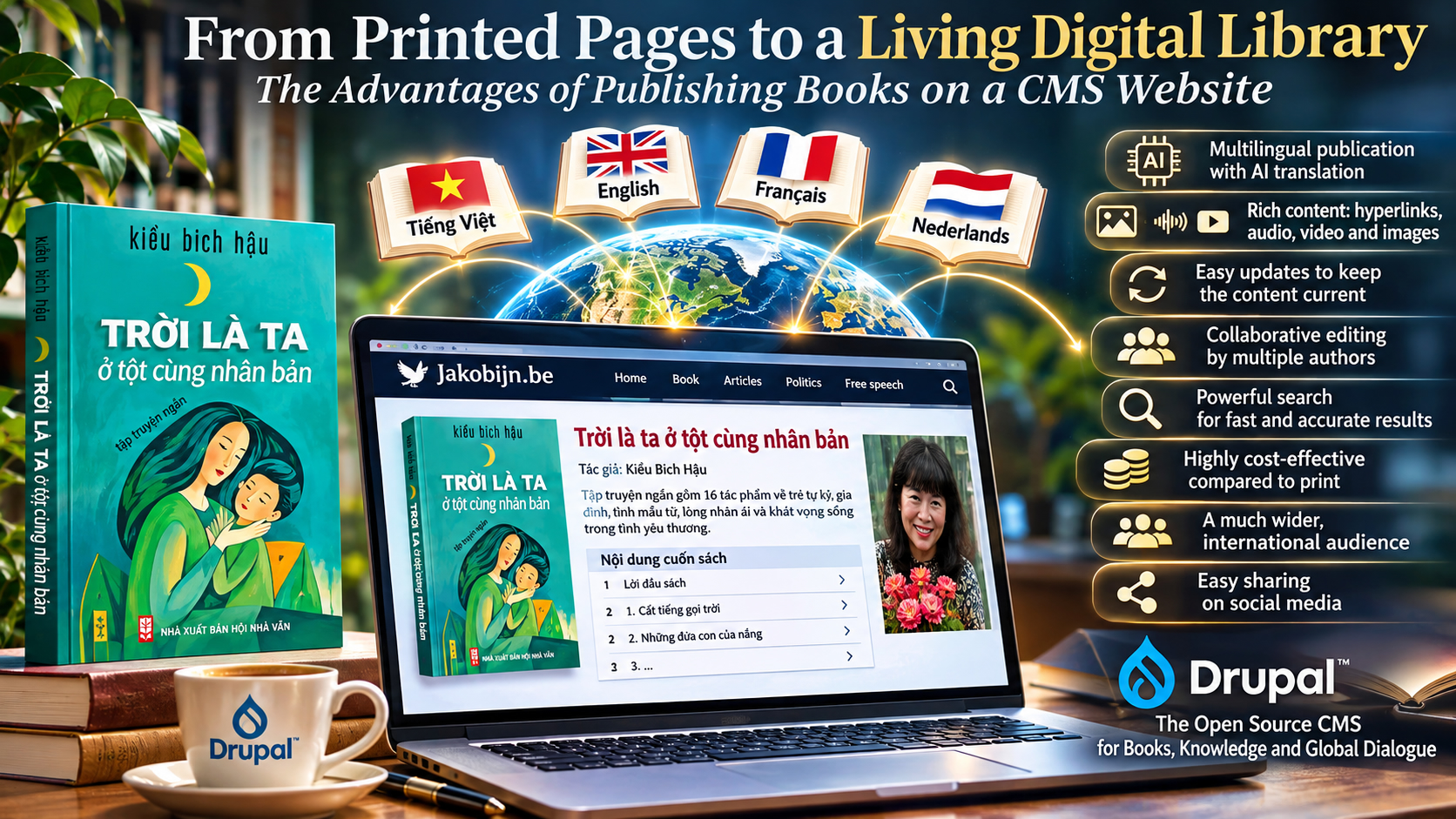
The experience of publishing Kiều Bích Hậu’s Vietnamese short-story collection on Jakobijn.be offers a practical glimpse of how independent publishing may develop in the years ahead.
By Frank Dumon
A small publishing project with a much larger meaning
 On 21 November 2026, the Vietnamese-language edition of Trời là ta ở tột cùng nhân bản, a collection of sixteen short stories by Vietnamese author Kiều Bích Hậu, appeared on Jakobijn.be. Its subject matter—autism, family life, social prejudice, personal dignity, compassion and the people who care for vulnerable children—makes it a particularly meaningful example of literature that deserves to travel beyond the boundaries of a printed volume.
The book did not arrive as a ready-made website. It began as a PDF of a printed publication. The text had to be prepared for the web; the cover had to be extracted from a complete printer’s layout; and the website’s Book structure had to be configured.
Webmaster Olivier Debaere helped bring the publication online. The resulting site presents a book landing page, its original Vietnamese cover, a table of contents and twenty linked components: a foreword, sixteen stories and three concluding literary commentaries.
That is an accomplishment in itself. More importantly, it demonstrates a broader possibility: a content management system, or CMS, can turn a book from a single physical object into an accessible, searchable, expandable and potentially multilingual body of work. The change is not simply one of format. It changes how a publication can be discovered, discussed, maintained and connected with its readers.
1. One work, four languages—and potentially many more
Traditional international publication often means negotiating separate editions, commissioning expensive translations, arranging new layouts and distributing each language version through its own channels. A multilingual CMS offers a different architecture: one editorial project can have linked versions in Vietnamese, English, French and Dutch, each with its own readable pages and language-specific web address.
Drupal’s Content Translation system supports translated titles, body fields and other content elements. AI-assisted translation can dramatically accelerate the creation of first drafts, including lengthy chapters. What once demanded a large production effort can now begin with an original manuscript and a carefully managed editorial workflow. Drupal even has an optional AI Translate integration designed to generate translations within its content system.
But possibility must not be confused with completion. As of this article, Kiều Bích Hậu’s book is demonstrably available on Jakobijn.be in Vietnamese; English, French and Dutch editions are opportunities for future publication, not editions that should be presented as already released. AI also does not guarantee literary fidelity. Metaphors, cultural references, irony, speech patterns and emotional nuances require human scrutiny, preferably by a proficient reader of the target language and, where possible, the author.
The ideal model is straightforward: Vietnamese remains the authoritative original; AI assists with draft translations; people review them; the author approves them; and Drupal makes each approved edition easy to find. This could introduce Vietnamese literature to new readers without erasing its distinctive voice.
2. A book can contain more than text
A printed book can include illustrations, photographs and footnotes. A web publication can add another dimension without sacrificing the original prose. A chapter may link directly to historical documents, scholarly sources, an author’s interview or a related essay. Photographs can be placed alongside the passage they illuminate. Audio can bring the writer’s voice to the reader. A video can record a discussion, a reading or a visit to a setting described in the work.
For example, a future presentation of Kiều’s collection could offer a recorded Vietnamese reading of a story, optional subtitles in another language, or an interview in which she explains how it was written. These are ideas for future additions, not features currently verified on the published book pages.
Drupal’s Media system is designed to manage and reuse media across a website. Done well, such material becomes a set of thoughtful editorial layers rather than an obstacle between the reader and the story. Accessibility matters: images need meaningful alternative text, audio needs transcripts and videos need appropriate captions. A book that can be listened to, enlarged, navigated by keyboard or read with assistive technology may serve people who cannot comfortably read a conventional printed edition.
3. A publication can be maintained without losing its identity
The phrase “living book” needs careful interpretation. A work of fiction is not a news bulletin, and an author’s finished sentences should not be silently rewritten each time new information appears. Nevertheless, the surrounding publication can evolve. A literary introduction can be expanded, bibliographical details can be corrected, references can be repaired, and contextual essays can be added. If a genuine correction to the literary text is approved, a revision history can record the change.
Drupal supports editorial revisions and, when configured, moderation workflows that distinguish drafts from approved public versions. That offers a practical advantage over a PDF circulated years earlier: readers can reach a clearly identified current version while editors preserve a record of changes. The strongest approach is to preserve the original text, date substantive changes and maintain separate editorial notes where appropriate.
For historical, scientific and educational books, this capability is even more significant. New archives, revised statistics, corrections and relevant discoveries can be linked to existing chapters without requiring a completely new print run. Instead of becoming less useful every year, a properly maintained digital publication can become more informative.
4. Several people can contribute without surrendering editorial control
Book publication need not be a one-person technical operation. The author can supply and approve the text; translators can prepare language versions; editors can check consistency; a historian or subject specialist can examine supporting material; and a webmaster can maintain the platform. Drupal’s roles, permissions and editorial workflows can separate these responsibilities.
Kiều’s book also illustrates a simple form of such cooperation: the writer provides the literary work, the website owner arranges publication, and the webmaster solves the technical problems. The next stage could include translation reviewers and invited commentators. Crucially, collaboration does not require everyone to have unrestricted access to the website. Contributors may work through documents and editorial review, while only authorized people change published pages.
The gain is both practical and intellectual. Specialist knowledge can improve a publication, but the author’s name, moral rights and final decisions must remain visible and respected.
5. Readers can search a book instead of hunting through hundreds of pages
A printed book demands a table of contents, an index or considerable patience. A digital book allows readers to follow chapter links, search for names and subjects, and return directly to a specific section. In Drupal, the Book module organizes related pages in a hierarchy, while a configured site search can index their content. More sophisticated implementations can use Search API to add filters, language selection and relevance-based results.
Imagine a reader looking for passages about motherhood, educational support, stigma or inclusion. Rather than scanning a PDF page by page, the reader could potentially find relevant passages in several chapters and move immediately to them. Researchers and teachers might build lessons around precise chapter links; translators could locate recurring terms; readers could share an exact story rather than ask someone to find page 246 of a printed edition.
This benefit depends on implementation. Placing text online does not automatically make a site’s internal search excellent: chapters must be indexed properly, language handling must work and the search interface should remain understandable. But it creates the foundation for a far more useful discovery experience.
6. Lower distribution costs, with an honest accounting of expenses
The economic difference is substantial. For a digital edition, every additional reader does not require another printed copy, another package or another shipment. There is no physical inventory to store, no postage for every download and no need to reprint the entire book because a hyperlink or introduction has changed.
A website that already exists can also serve several purposes at once: publishing articles, hosting books, archiving interviews and presenting translations. In that context, the additional cost of placing a new book online may be relatively low compared with organizing a separate physical distribution operation. Open-source software such as Drupal avoids compulsory proprietary licensing fees for the CMS itself.
Still, online publication is not free. Hosting, domain registration, backups, security updates, accessibility work, proofreading, translation review, permissions, technical support and long-term preservation all require time or money. A website can reduce printing and distribution expenditure, but it does not eliminate the value—or cost—of professional editorial work. Its strongest financial advantage is the ability to reuse an existing publishing infrastructure and distribute another copy to a reader at very low marginal cost.
7. From a local readership to an international public

A printed Vietnamese book often reaches readers through particular bookshops, cultural institutions, personal networks and distribution arrangements. A public web address makes geographical distance much less of a barrier. A Vietnamese student in France, a researcher in Belgium, a family in Canada or a reader in Hanoi can in principle open the same chapter without waiting for an international shipment.
Four carefully edited language editions could widen that opportunity further. English may provide access to an extensive international readership; French can serve readers in several continents; Dutch connects the project to audiences in Belgium and the Netherlands; and Vietnamese retains the book’s original language, cultural setting and literary character.
Search-engine visibility can reinforce the result. Google recommends distinct URLs for translated versions to clarify their relationship. But publication is not a guarantee of high search rankings or a large audience. Discoverability still depends on sound structure, accurate metadata, useful links, sustained promotion and readers who find the work relevant.
8. Each chapter becomes something readers can share
A book page with its own stable URL can circulate independently through email, social networks, newsletters, literary groups and educational websites. A reader moved by one story does not need to recommend an entire 312-page printed volume before beginning a conversation; the reader can share the story itself and, through the chapter navigation, lead someone back to the complete collection.
This is especially promising for short fiction. Individual stories have natural titles, themes and emotional arcs, making them suitable for discussions among reading groups, teachers, scholars or people concerned with the subject matter. A social-media post might introduce one story, provide a short quotation where authorized, and link to the complete text on the author’s own publication page.
Social platforms may change their rules and algorithms, but a properly maintained website offers a more durable home for the complete publication. Social media can bring readers to the book; it should not have to become the book’s permanent archive.
9. Greater independence—and greater responsibility
There is an important cultural argument for independent publishing. A writer and publisher who control their own CMS can determine the structure of a book, maintain its archives, present multilingual editions and correct mistakes without waiting for a commercial platform to redesign its product. The website can provide a stable point of reference for the work and for its relationship to other publications.
That independence has limits. Copyright agreements must permit online publication and translation; images and recordings require appropriate permissions; personal data must be protected; and the operator must actively maintain secure software and reliable backups. A digital text is not preserved merely because it is online today. Long-term accessibility requires archives, exports, a clear editorial record and a plan for what happens if the website eventually changes hands.
For literature in particular, the original author should remain unmistakably identified even when the technical CMS account is held by someone else. The publication interface must never obscure literary authorship.
10. What might come next, between 2027 and 2031?
The following are plausible developments and editorial proposals, not promises or predictions that these features will appear automatically on Jakobijn.be.
More reliable AI-assisted multilingual workflows. A change to a foreword or factual note could trigger a notification that its three translations need review. Translation memories and human-approved terminology lists could improve consistency across a large collection. The gain would be faster maintenance, while final literary judgment remains human.
Listening as an ordinary way of reading. With the author’s consent, professionally recorded or carefully reviewed synthetic narration might make Vietnamese, English, French and Dutch editions available to listeners. Synced text and audio could support readers learning Vietnamese and people with visual or reading difficulties.
Search by meaning rather than exact wording. Drupal’s AI Search project already explores semantic search: finding passages related to an idea even when the reader does not use precisely the words in the text. In a future literary library, someone might ask where a collection discusses the conflict between social prejudice and parental love and be directed to relevant chapters. Such systems would require sound indexing, source-linked answers and safeguards against fabricated summaries.
Richer scholarly editions. Chapters could be linked to interviews, contextual notes, photographs and bibliographies. Teachers could build study routes through selected texts. Editorial additions would remain distinct from the author’s original fiction.
Several reading formats from one managed source. A CMS can potentially supply web pages alongside downloadable formats, including EPUB or printable PDF, through compatible tools and careful layout work. That could serve readers who prefer an e-reader, want offline access or need a physical copy, while the website remains the central source of updated information.
None of this requires abandoning the printed book. A well-designed digital edition can support print rather than replace it. The important change is that one work may reach readers through several formats and languages without creating unrelated publishing projects for each one.
A practical principle: technology should serve the text
The transformation from PDF to a structured digital book is not effortless. Formatting errors must be corrected, original-language text must be checked, navigation must be tested and translations must be approved. Multimedia can distract instead of enlighten. AI-generated descriptions can be inaccurate. Website operators must resist the temptation to treat technical ease as permission to alter an author’s work without consultation.
For Kiều Bích Hậu’s collection, the responsible next step is therefore not to declare an international edition finished, but to let its author evaluate the Vietnamese publication, correct any issues and decide how the book should develop. After that, additional language versions and media can be prepared with a clear approval process.
The real achievement of a CMS is not that it makes editorial responsibility unnecessary. It is that it gives people more ways to exercise that responsibility, transparently and collaboratively.
Conclusion: a book can have a second life without losing its first
A printed book remains a beautiful and culturally important object. It carries a particular edition, a particular moment in the author’s life and a tangible connection with the reader. A CMS publication offers something different: a book that can be encountered from another country, searched by topic, discussed through a link, supplemented with carefully chosen media and presented in several languages.
The first Vietnamese online edition of Trời là ta ở tột cùng nhân bản shows what even a modest independent publishing initiative can accomplish when an author, an editor and a technically capable webmaster work together. It also suggests a larger future for independent literature and for archives that might otherwise remain confined to paper or inaccessible files.
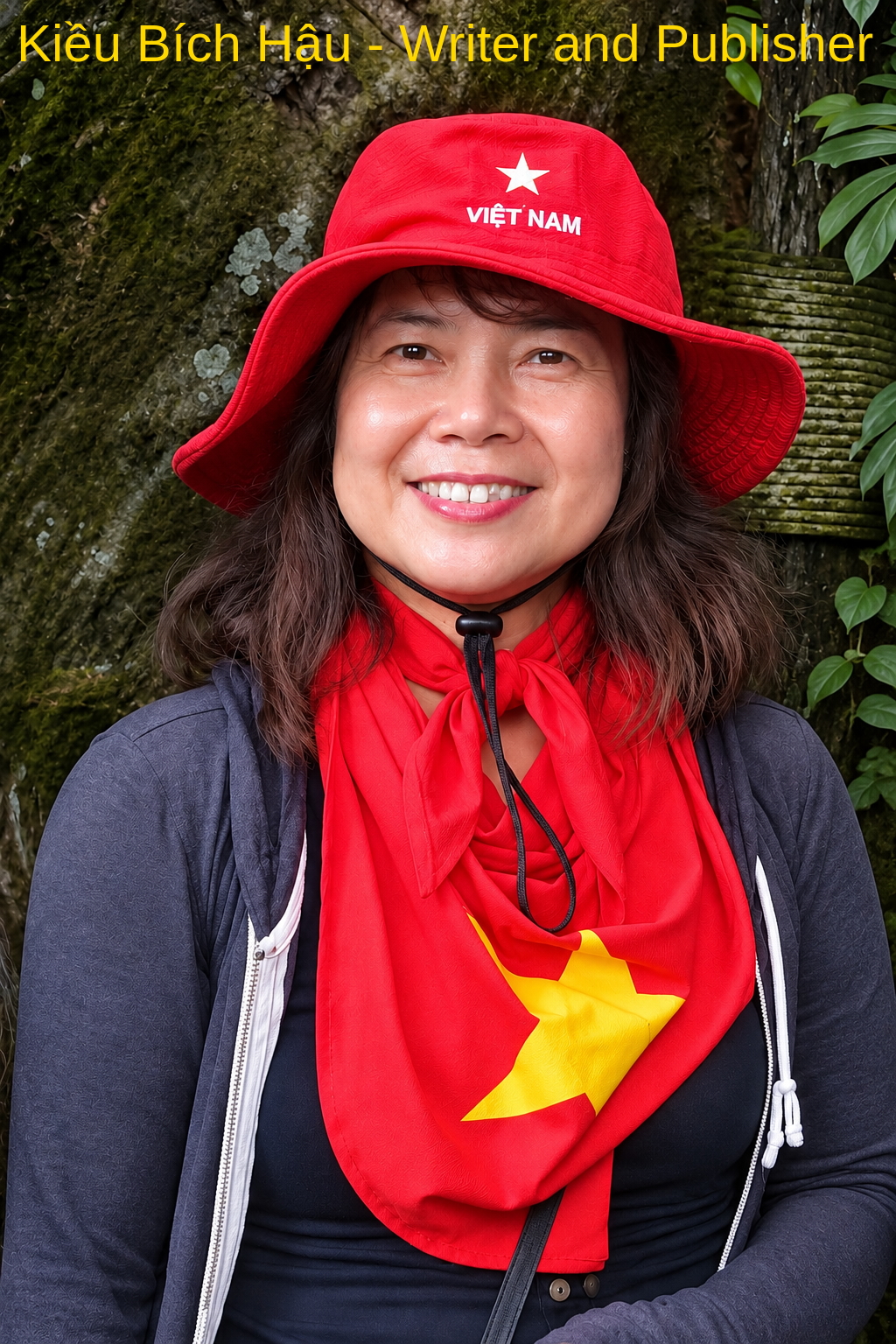
Trời là ta ở tột cùng nhân bản consists of 16 short stories centered on a single theme: children with autism or depression - a subject still relatively new to Vietnamese literature, which Kiều Bích Hậu is perhaps one of the very first authors to explore.
The printed book preserves a work. The well-maintained digital library can help that work continue to find new readers. The strongest future for publishing is not necessarily print or digital, but print and digital, supported by human editorial care, open technologies and the growing possibilities of responsible AI.
Sources and further reading
- Kiều Bích Hậu, Trời là ta ở tột cùng nhân bản — Vietnamese online edition, Jakobijn.be.
- Drupal — Book module: organization, navigation and collaborative authoring.
- Drupal — Content Translation overview.
- Drupal — AI Translate project.
- Drupal — Media module overview.
- Drupal — Editorial workflow and revisions.
- Drupal — Search API.
- Drupal — AI Search (semantic search).
- Google Search Central — Managing multilingual websites.
- W3C Web Accessibility Initiative — Writing for web accessibility.