
Prompt Engineering in Practice: How AI Transformed 'Sultans of Swing' into 'The Alley Cats of Swing'
By Frank, September 19, 2026
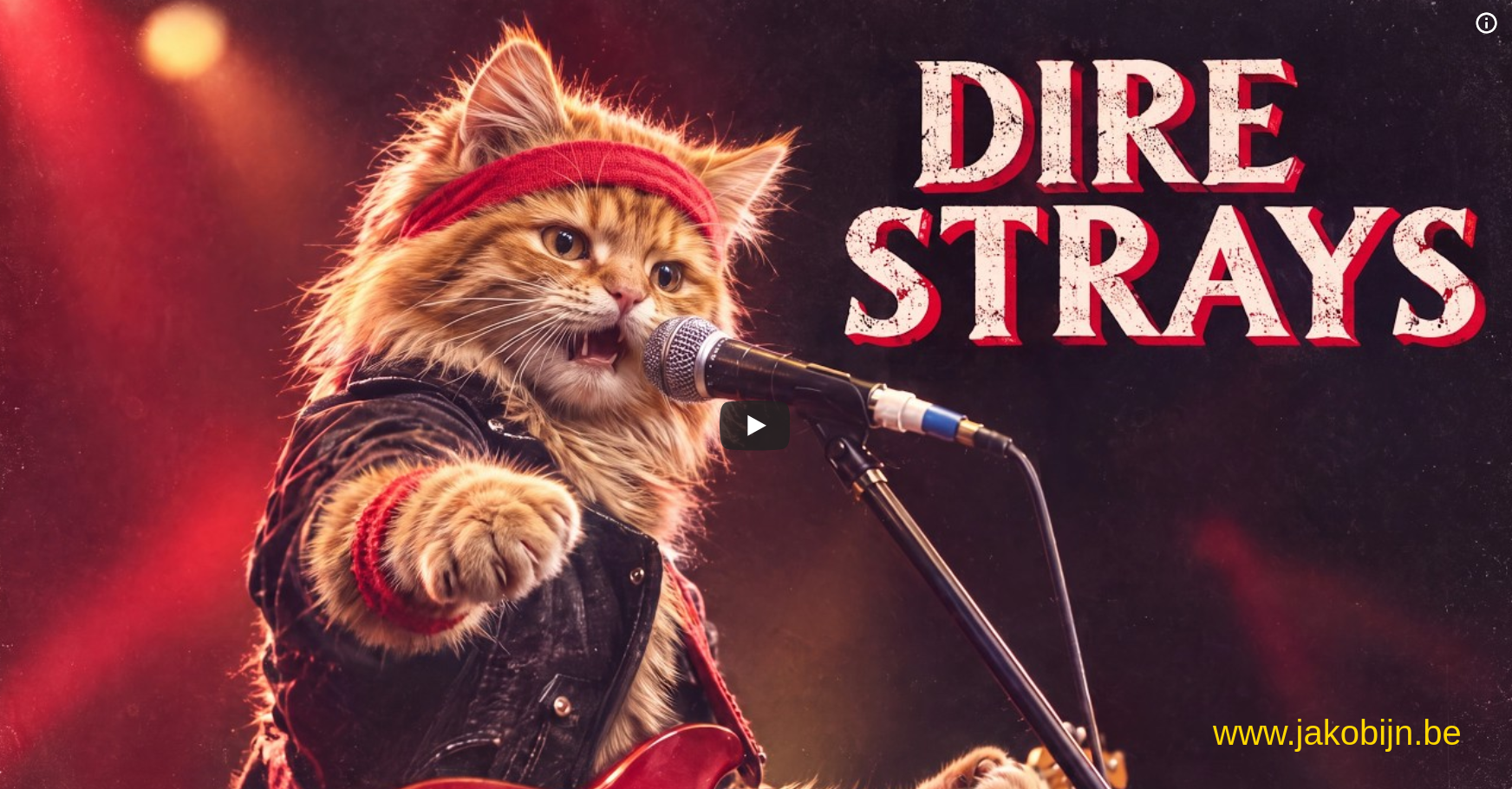
The graphical capabilities of artificial intelligence are now virtually unlimited. As we recently discussed in our article on why open-source AI and new operating systems are displacing traditional tools like Photoshop, power is shifting from expensive software packages to accessible, intelligent workflows. Today, we dive deeper into the world of video-to-video transformation. We analyze a playful yet technically impressive case study: the transformation of the classic Dire Straits - Sultans Of Swing into the animated parody Dire Strays - The Alley Cats Of Swing. How is a legendary band transformed into a group of playing street cats without losing the iconic atmosphere and movement? The answer lies in advanced Prompt Engineering.
The Transformation: From Video 1 to Video 2
The challenge in projects like this is not generating a random cat, but preserving the temporal consistency (movement over time) and the original composition of the video. The AI must understand that the guitarist is not just any cat, but a cat making precisely the same guitar movements, in the same lighting, and within the same 1970s jazz club atmosphere.
- Video 1 (Input): Dire Straits - Sultans Of Swing
- Video 2 (Output): Dire Strays - The Alley Cats Of Swing
The AI Tools Used in the Workflow
Such a transformation rarely results from a single 'magic button'. It is an interplay of specialized tools. Based on the current state of the art in 2026, the most effective workflow consists of the following components:
1. Prompt Crafting & Conceptualization
Before pixels are generated, the instruction must be perfect. This is where language models with large context windows come into play, such as Moonshot AI (Kimi). These models are extremely suitable for structuring complex, detailed visual descriptions into workable AI prompts, including camera angles, lighting, and style references.
2. Reference Image Generation (Image-to-Video Basis)
To determine the exact look of the 'alley cats', fast, iterative text-to-image generators are indispensable. Tools like the Perchance AI Image Generator offer a low-threshold, often open-weight environment to quickly test which styles (e.g., 'vintage comic', 'cinematic photo', or 'realistic fur') work best before moving on to heavier video computations.
3. Video-to-Video & Character Replacement
The heavy lifting is done by specialized video models. Options setting the standard in 2026 for this type of style transfer include:
- Stable Video Diffusion (SVD) img2vid: A powerful open-source model that takes a static reference image (the generated cat) and animates it based on the motion data of the original video.
- Advanced Video Inpainting / Character Swap: Tools such as Runway (Gen-3 architecture) or open-source alternatives with ControlNet, which 'lock' the silhouettes and poses of the original band members and project the new texture (the cat) over them.
The Art of the Prompt: Concrete Examples
Prompt engineering is, as we stated earlier, the art of formulating inputs that guide AI systems toward the desired output. A bad prompt yields a random cat; a good prompt yields a musician who happens to be a cat. Here are the layered prompts required for such a result:
The Base Prompt (Global Style)
"Cinematic video, 1970s jazz club atmosphere, smoky dim lighting, warm stage lights. Anthropomorphic alley cats playing musical instruments, realistic fur texture, wearing vintage 1970s tailored suits. Maintaining exact original human poses and movements, high temporal consistency, 4k resolution, photorealistic."
Specific Scene Prompts (per Band Member)
For best results, the video is often approached in segments or per character:
- The Guitarist:
"Orange tabby cat playing a black electric guitar, standing upright, dynamic fingerpicking motion, vintage suit, focused expression, cinematic rim lighting, shallow depth of field." - The Bassist:
"Black and white tuxedo cat playing bass guitar, swaying to the rhythm, dim jazz club background, realistic fur details, professional musician stance." - The Drummer:
"Grey tabby cat behind a vintage drum kit, energetic drumming pose, motion blur on drumsticks, dramatic stage lighting, highly detailed fur and whiskers."
The 'Negative Prompt' (What should the AI not do?)
Equally crucial is excluding unwanted elements: "cartoon, 3d render, anime, deformed paws, extra limbs, morphing, flickering, loss of instrument shape, modern clothing, bright daylight."
Step-by-Step Workflow for the Independent Creator
How do you set this up yourself? The Democracy of AI means you don't need a Hollywood budget, but you do need methodology:
- Frame Extraction: Extract keyframes from the original video where the pose is clearest.
- Prototyping: Use a tool like Perchance or Moonshot AI to generate the perfect 'cat in a suit' that resembles the pose of the frame.
- Video Transformation: Load the original video and the generated reference images into a video-to-video model (such as Stable Video Diffusion or a similar open-source pipeline). Use ControlNet (OpenPose or Depth) to force the movement of the original video onto the new cat image.
- Inpainting & Refinement: Use AI inpainting to correct any artifacts (e.g., a human hand sticking through the fur) frame by frame.
- Audio Sync & Finalization: Add the original, unaltered audio track of 'Sultans of Swing' in a traditional video editor. The humor and effect arise precisely from the contrast between the familiar, serious music and the absurd visual reality.
Conclusion and Reflection
The transformation of 'Sultans of Swing' into 'The Alley Cats of Swing' is more than a playful gimmick. It is a demonstration of how Prompt Engineering and open-source AI tools can take over the roles of the director, the art director, and the VFX specialist.
For independent journalists and creators, this means liberation from expensive, closed ecosystems. It enables us to tell complex visual stories, or in this case, provide existing cultural goods with a new, critical, or humorous layer. The technology is here; the challenge now lies in the creativity and precision of the instructions we give it. The cat is out of the bag, and he is playing guitar.