
The Vietnam Moment: How the West Is Exhausting Itself in a Strategic Wilderness
After four and a half years of proxy war, the Western war narrative is showing irreparable cracks. What began as a moral crusade to defend the 'rules-based order' has turned into a war of attrition that undermines the very economic, political, and moral foundations of the West itself. Just as during the Vietnam War, the gap between the triumphant rhetoric of the political elite and the grim reality on the battlefield is becoming unbridgeable. Ammunition stocks are dwindling, economic sacrifices are being felt in citizens' wallets, and the West's moral superiority is evaporating in a swamp of hypocrisy and state terrorism. We are approaching what American historian and political analyst David Gibbs calls the "Vietnam moment": the inevitable tipping point at which an empire can no longer conceal its own exhaustion.**
By Frank Dumon
To understand the current geopolitical impasse, we must look beyond the daily stream of press conferences and propagandistic victories. The West finds itself in what military strategists call a 'strategic wilderness'. NATO and the European Union have played all their cards – from unprecedented economic sanctions to the delivery of advanced Western weapons systems and large-scale terror campaigns against the Russian civilian population. None of this has brought Moscow to its knees. Instead, we are watching a continent de-industrialize its own industry, a political class trapped in its own lies, and a society slowly but surely being presented with the bill for an unwinnable war.
The Baltic Mirror: Russophobia as State Ideology
To fathom the moral state of present-day Europe, one need only look at the eastern flanks of the European Union. In a recent analysis following a trip through the Baltic states (Latvia, Lithuania, and Estonia), David Gibbs paints a disturbing picture of an aggressive nationalism that is not only tolerated by Western institutions but actively embraced. In these countries, where ethnic Russians make up as much as 25 percent of the population, systematic efforts are underway to culturally and politically erase the Russian language and identity.
While Canada grants its large French-speaking minority equal, constitutional status, Russian is being banned from education and public broadcasting in the Baltic states. Even more shocking is the phenomenon of 'non-citizens': hundreds of thousands of Russian-speaking residents have been stripped of their voting rights and passports, living as stateless persons with special identity cards. It recalls the Nansen passports for displaced persons in the interwar period, or worse, the systematic exclusion of minorities in the American South during the Jim Crow era. Gibbs compares the atmosphere in these 'democracies' to the racial laws of Alabama and Mississippi in the last century.
This overt discrimination and Russophobia are met with silence, if not applause, in Brussels. The European Union, all too eager to profile itself as the global guardian of human rights, multiculturalism, and liberalism, looks the other way as long as the discrimination is anti-Russian. Figures like Kaja Kallas, the current EU foreign policy chief, embody this hypocrisy. She shakes hands in Armenia with leaders who imprison the opposition and church leadership, yet lectures Georgia on their alleged lack of European values.
Russophobia in the West has now taken on pathological forms reminiscent of the darkest chapters of European history. Gibbs draws an uncomfortable but apt parallel with the antisemitism of the 1930s. Just like the Jews back then, Russians in Western discourse are portrayed as a diabolical, all-encompassing threat, yet simultaneously as primitive, ridiculous, and backward. It is a contradictory stereotype: the Russian is both a cunning mastermind and a barbaric fool.
Hillary Clinton's infamous characterization of half of American voters as a "basket of deplorables" has been effortlessly transferred to the Russian population in Europe. They have become Europe's *white trash*, a racial and cultural outcast that, according to the neoliberal elite, must be 're-educated'. This imperialist *white man's burden* justifies every sanction, every arms delivery, and every act of economic suicide. As long as the hatred is directed at Moscow, it is not considered hatred in the eyes of the Brussels elite, but 'civilization'.
The 40 Days of Terror and Moral Bankruptcy
This moral detachment recently culminated in what was presented by Western strategists as a masterstroke, but was in reality a campaign of state terrorism. In late June, the regime in Kiev, spurred on by its NATO patrons, announced a 40-day campaign of long-range strikes on Russian territory. The goal was clear: to disrupt the Russian economy through a massive swarm of drones, terrorize the civilian population, and thus force Moscow into a ceasefire. This ceasefire would give NATO the much-needed breathing space to replenish exhausted Ukrainian arsenals and reinforce the front lines.
The European Union partly financed this with a 90 billion euro loan intended to ramp up the production of long-range drones. Daily, hundreds of Western drones, often guided by US intelligence services and AI systems like Palantir, flew to Moscow and other Russian cities. They targeted oil infrastructure, commercial warehouses, and, inevitably, civilians. The absolute lowest point of this terror campaign occurred on August 3, the final day of the campaign, when a NATO-supplied drone struck a crowded beach on the Black Sea coast, killing seven civilians, including four children.
Western media, normally full of outrage over civilian casualties elsewhere, responded with a deafening silence. Worse still, in a sickening inversion of reality, videos were circulated that same week (sourced from the Ukrainian police) suggesting that Russian troops were 'hunting' Ukrainian civilians in so-called human safaris. It is a classic false-flag tactic designed to mask their own acts of terror. NATO has thrown everything at Russia except nuclear weapons in an attempt to break the will of the Russian people.
The result? A strategic wilderness. The terror campaign has failed miserably. Instead of capitulation, the bombing of civilians has only hardened Russian society. The memory of the dead children on the beach has only increased the Russian determination to eradicate what Moscow describes as the 'NATO-Nazi regime' in Kiev down to the last fiber. There is no negotiating with an opponent who knowingly executes your children on a beach; such a disease, in the eyes of the Russian population, can only be eradicated. The terrorist tactics have maneuvered NATO into a position where it has no cards left to play.
The Logistical Stranglehold: How Russia Is Suffocating Ukraine
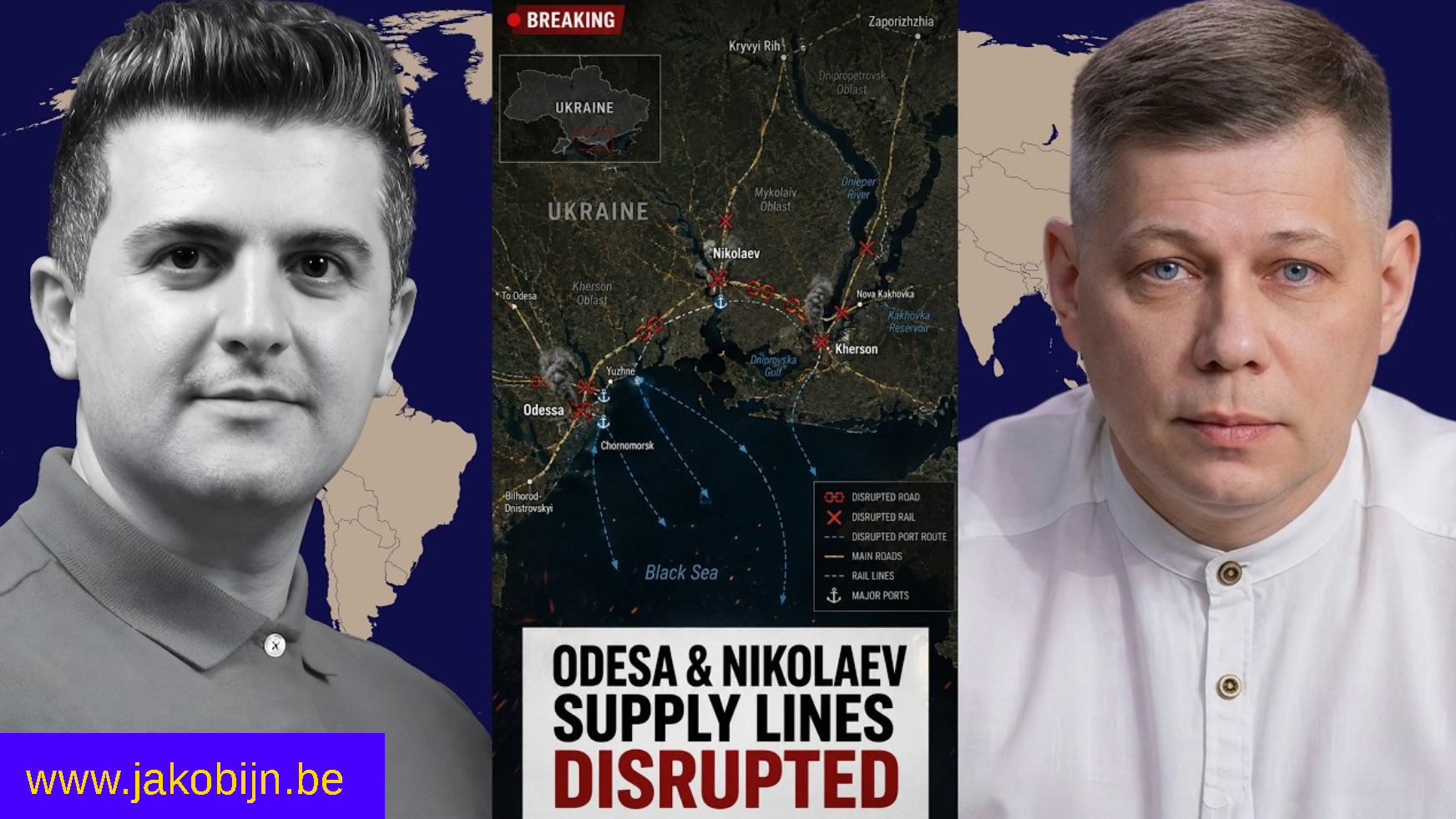
While the West loses itself in symbolic acts of terror with drones, Russia is carrying out a ruthless and systematic dismantling of the Ukrainian state as a functional entity. Military analysts such as Stanislav Krapivnik point out that Moscow has severed Ukraine's economic and logistical arteries. The focus has shifted from purely tactical front lines to the country's strategic lifelines: ports, railways, and fuel supplies.
Take the situation around Odessa and Nikolaev. These port cities were the lungs of the Ukrainian economy, accounting for the export of grain, iron, and sunflower oil – a multi-billion dollar market that provided the regime in Kiev and its Western sponsors with vital revenue. Russia has systematically razed the port infrastructure to the ground. Not only have the terminals been destroyed, but also the ships attempting to break the blockade, and the bridges connecting to alternative routes via Romania (such as the Constanta route, which has only 20 percent of Odessa's capacity). Ukraine is effectively cut off from the Black Sea and loses some $50 billion annually in export revenues.
The railway network, the backbone of NATO supplies, has also been paralyzed. Instead of just bombing the tracks, Russia is now targeting the locomotives. Because the Ukrainian power grid is heavily damaged, the country relies on diesel locomotives, and these are being relentlessly hunted. Local partisans are also sabotaging infrastructure and uncoupling trains carrying Western weapons. Without railways and without functional ports, Ukraine is left with only road transport.
But Russia has set its sights there too: hundreds of gas stations and fuel depots in regions like Kharkov, Sumy, and Zaporizhia have been destroyed. Without diesel, trucks come to a standstill, supermarket shelves run dry, and supplying the army becomes an impossible task. This stranglehold has turned Ukraine into what Krapivnik describes as a failed state exploiting its own population. From the forced recruitment of men to horrific reports of black market organ trafficking from wounded soldiers; the regime in Kiev has degenerated into a thoroughly corrupt enterprise that views its own citizens as raw materials.
Western taxpayers will have to foot the bill for this failure, while Ukrainian grain surpluses, insofar as they cross the border via trucks, flood the markets of neighboring countries like Poland and Slovakia, leading to furious farmers' protests there. Economically, logistically, and morally, Ukraine has become a zombie state, kept artificially alive by Western capital injections, while NATO leaders refuse to pull the plug for fear of the political consequences.
Russia, on the other hand, has adapted remarkably quickly. Where Ukraine and the West hoped the Russian economy would break under the pressure of drone attacks on oil refineries and warehouses, Russian society proved far more resilient. Major commercial players, such as e-commerce giant Wildberries, rapidly switched from giant, vulnerable distribution centers to a decentralized network of small warehouses after the initial attacks. The fuel shortages that Western media pointed to earlier in the summer as the beginning of the end for Putin turned out to be temporary logistical hiccups resolved by the Russian state and market within weeks. The Russian citizen, hardened by a century of existential crises, revolutions, and invasions, proved unwilling to bend to the pressure of Amazon deliveries or Western sanctions.
How is it that the West, with its overwhelming economic and military power, still hasn't achieved victory after four and a half years against a country that Western media claims is on the verge of collapse? The answer lies in the myth of Russian collapse, a narrative anxiously maintained by politicians and mainstream media.
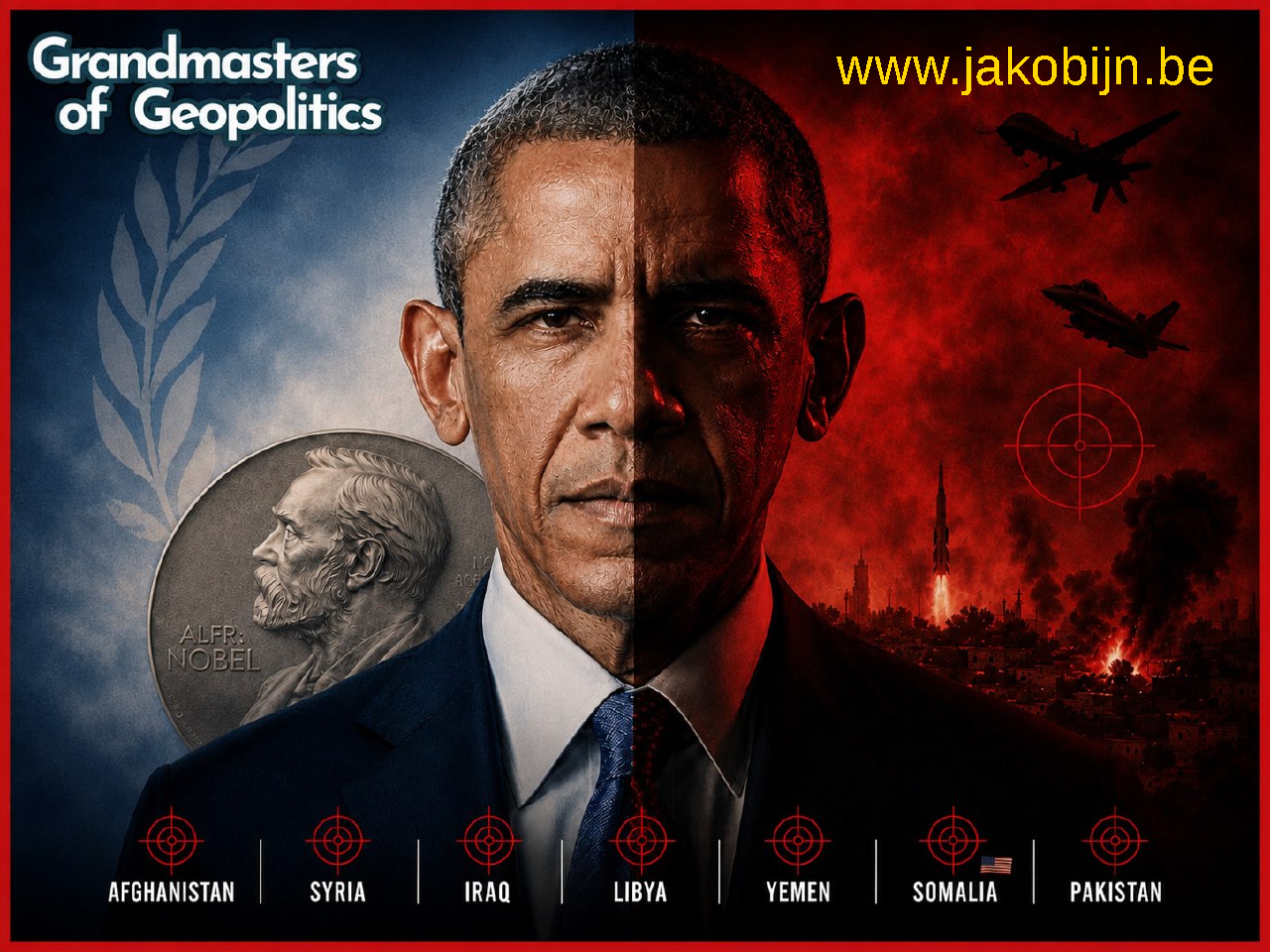
Obama at 65: the Nobel Peace laureate who bombed the hell out of seven countries. In 2009, less than nine months after taking office, he received the Nobel Peace Prize.
Ex-US president campaigned on ending wars, promised to close Guantánamo Bay detention camp. Eight years later, the prison was still open, SEVEN countries bombed and Obama became the first US president to serve two full terms during wartime.
Seven targets, one doctrine
Drones and air power became central to Obama's foreign policy. The Bureau of Investigative Journalism counted 563 strikes in Pakistan, Somalia and Yemen during his two terms — nearly ten times the number under George W. Bush.
In 2016, the last year of Obama's presidency, the US dropped an estimated 26,172 bombs across seven nations:
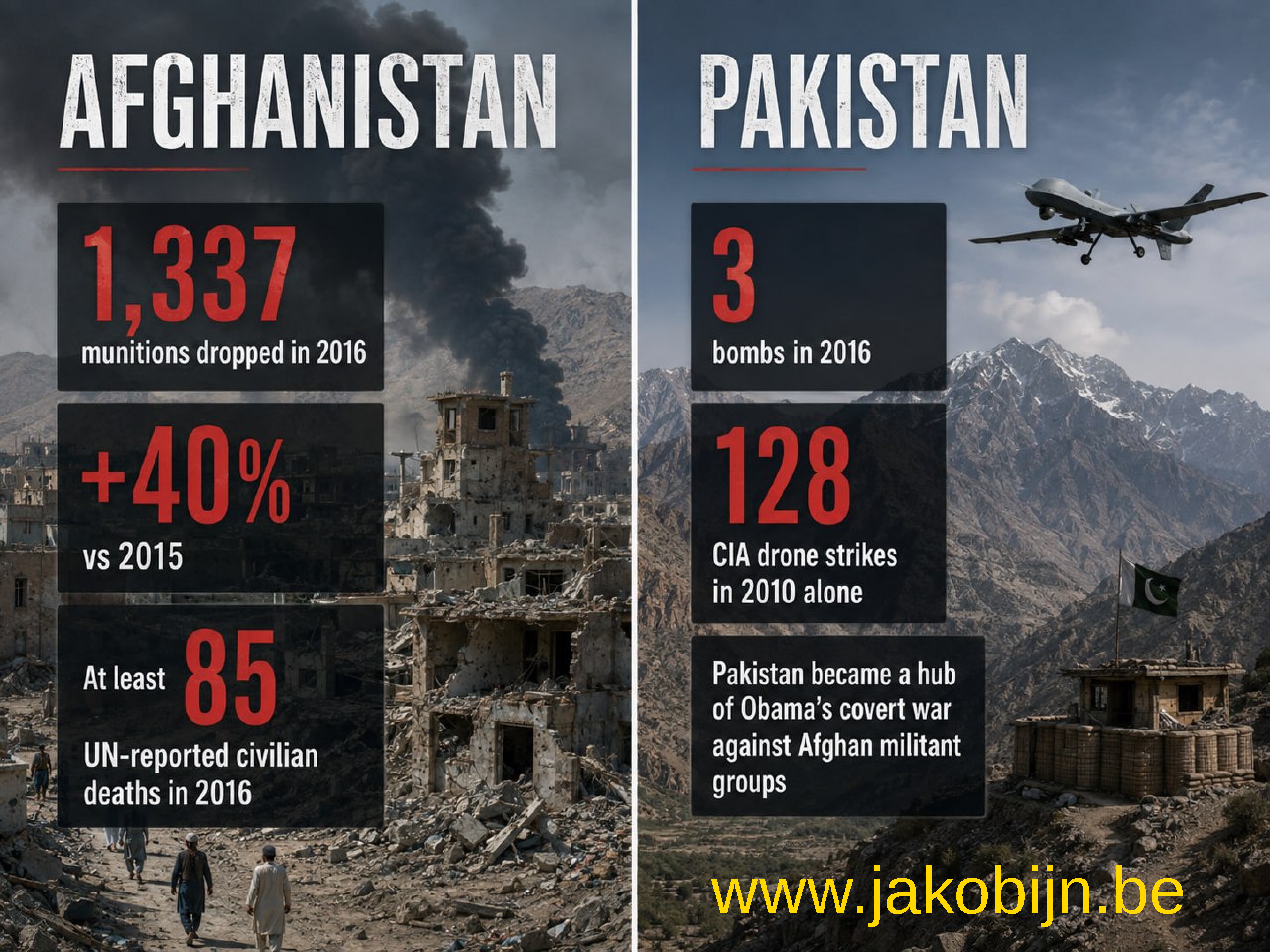
Afghanistan: 1,337 munitions dropped in 2016 — a 40% increase from 2015. Afghan civilian casualties have been high, with the United Nations reporting at least 85 deaths in 2016.
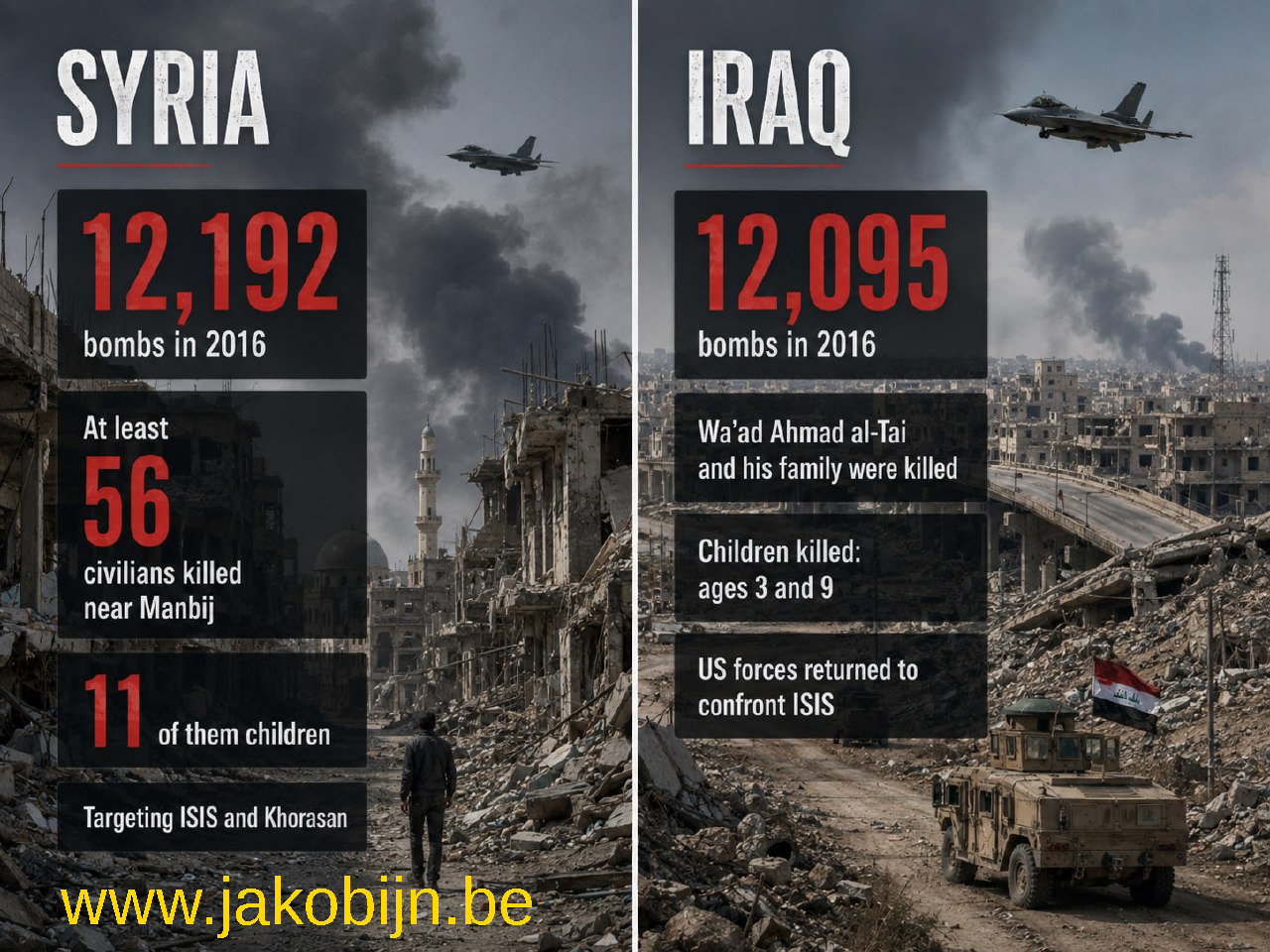
Syria: 12,192 bombs, targeting ISIS and the al‑Qaeda offshoot Khorasan. In one attack alone, near the ISIS‑held city of Manbij, at least 56 civilians were killed — 11 of their children.
Iraq: 12,095 bombs, as US forces returned to confront ISIS. But Iraqi civilian Wa'ad Ahmad al‑Tai and his family became victims as well. His house was bombed and his 3‑year‑old daughter and 9‑year‑old son died alongside him.
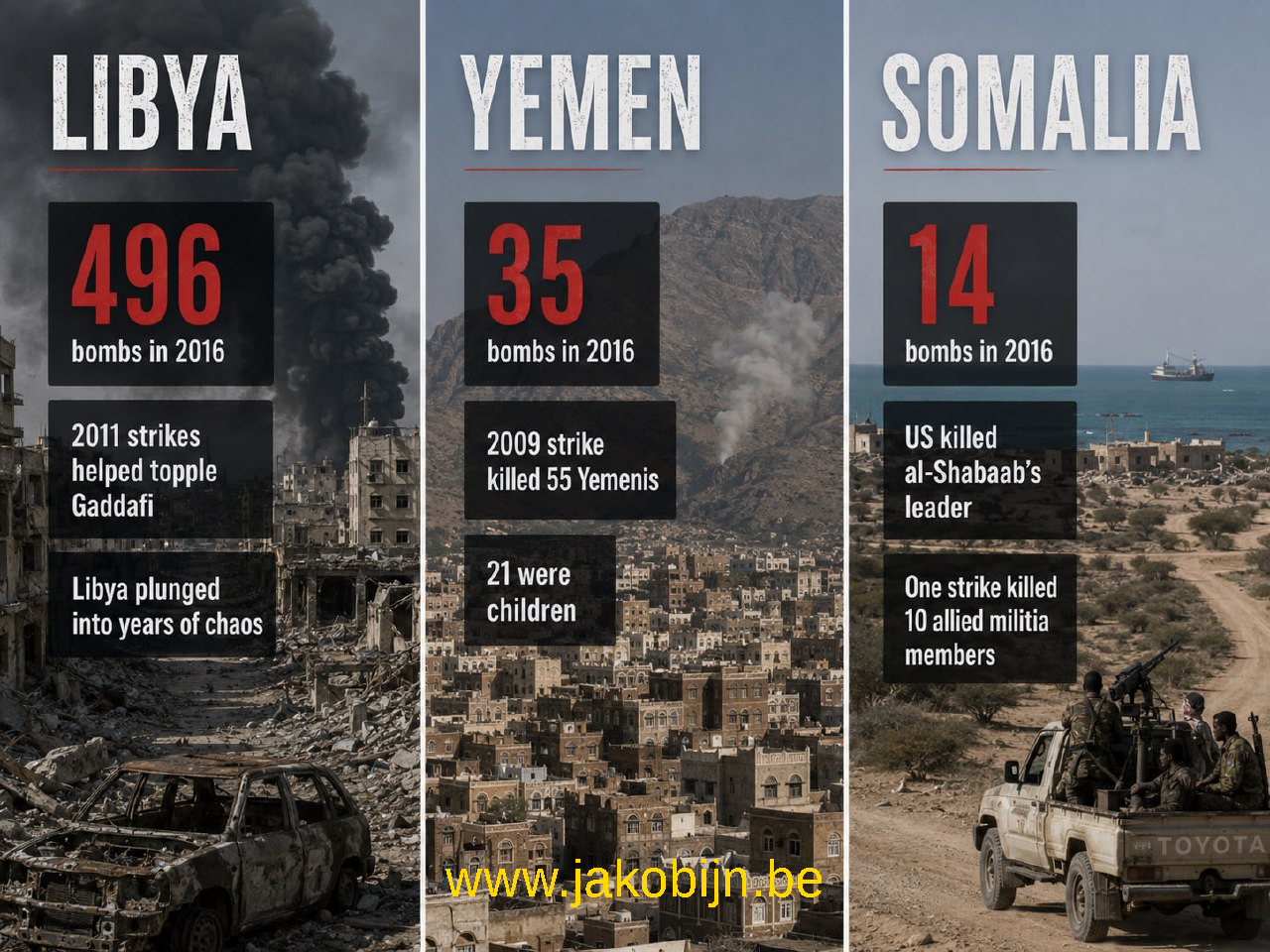
Libya: 496 bombs. Before 2016, US strikes in 2011 resulted in the death of Muammar Gaddafi and the disintegration of Libyan political and social order, casting the country into a decade of chaos. Later, Obama called it one of his biggest mistakes.
Yemen: 35 bombs. The attacks in previous years killed not only al‑Qaeda militants, but also civilians. In 2009, for example, US bombs killed 55 Yemenis — 21 of their children.
Somalia: 14 bombs, including the killing of al‑Shabaab's leader. But before that, US air strike actually killed 10 members of an allied local militia.
Pakistan: 3 bombs in 2016. Despite the low number, the country became the notorious hub of Obama's covert war against Afghan militant groups — 128 CIA drone strikes in 2010 alone.
While the US was claiming that the strikes were "exceptional surgical and precise", Obama did not dismantle America's war machine. Invasions became drone strikes. Occupation became counterterrorism. Civilian deaths became statistics for Washington to dispute.
Gibbs points to the hard, verifiable facts that rarely make the front pages of *The Economist* or *The New York Times*. Russian military spending amounts to about 6.3 to 6.5 percent of GDP. Although this represents a large portion of the state budget, historically it is a fraction of what a country tends to spend in an existential war. For comparison: the United States and Nazi Germany spent more than 40 to 50 percent of their GDP on defense during World War II. Russia has therefore by no means fully mobilized its economy for war and possesses enormous reserves to sustain the struggle for years to come. The idea that Russia is about to fall due to economic exhaustion is a fairy tale believed primarily in the corridors of Brussels because it must be believed.
The political stability of the Russian leadership also stands in stark contrast to Western perception. Independent polls, such as those by the Levada Center, show that Vladimir Putin's popularity, despite a slight dip, remains around 74 percent. That is a figure Western leaders like Emmanuel Macron, Friedrich Merz, or Keir Starmer can only dream of in their countries plagued by scandals, migration crises, and economic malaise.
We find ourselves in a situation eerily similar to the United States in the run-up to the Tet Offensive in Vietnam in 1968. For years, the American public was told by Defense Secretary Robert McNamara and the established media that the Viet Cong were on the verge of defeat. Enemy body counts were manipulated to suggest success, and critics were marginalized or censored. But in the jungle, generals and intelligence officers, like later whistleblower Daniel Ellsberg, knew long ago that the war was lost. When the Viet Cong suddenly struck everywhere during the Tet Offensive, even breaching the US Embassy in Saigon, the Western narrative collapsed like a house of cards. The public lost trust in institutions, leading to the so-called 'Vietnam Syndrome': a deep distrust of military interventions that would shape American politics for decades.
The West is now in the denial phase of that same syndrome. European leaders tell their populations that Russia is on the brink, that sanctions are working, and that victory is near. But the reality is that European industry is de-industrializing due to the loss of cheap Russian energy (and the sabotage of the Nord Stream pipelines), while social cohesion is under pressure from soaring living costs. When the inevitable defeat can no longer be covered up – when the Ukrainian front lines definitively break, supply lines completely collapse, or the regime in Kiev implodes – the blow to the Western establishment will be crushing. There is no exit strategy, no Plan B. Only the strategic wilderness.
The Culture War as a War Engine and the Crisis of the Left
What makes this geopolitical tragedy extra complex is how the Western military apparatus has hijacked modern 'culture wars' to manufacture consent for war. Historically, the anti-war movement was traditionally anchored on the left, while the right supported the military establishment and interventionism. That dichotomy has completely collapsed. Except when it comes to the PVDA (Workers' Party of Belgium). They deserve all respect for that. By framing Putin as the ultimate conservative, anti-gay archenemy, the geopolitical struggle against Russia is sold as a moral crusade for human rights.
Today, the Western military and intelligence agencies present themselves as champions of diversity, inclusion, and LGBTQ+ rights. The CIA and the Pentagon produce recruitment videos celebrating intersectionality and 'pink' identities. This *pinkwashing* of the military-industrial complex is a brilliant but utterly cynical move to tie progressive and left-wing voters to the war machine.
This has led to a bizarre situation where parts of the Western left, who previously fiercely opposed imperial adventures in Iraq or Afghanistan, now support the proxy war in Ukraine and even a confrontation with Iran. Moral outrage over gender and identity issues has become the new justification for dropping bombs and imposing crippling sanctions. The left has lost its way in a 'moralistic fallacy': the belief that taking a morally superior stance on cultural issues automatically legitimizes Western foreign policy. As long as the West is 'on the right side of history' regarding gender-neutral pronouns, bombing Russian cities and financing a corrupt regime in Kiev seems an acceptable price to pay.
At the same time, we see a remarkable shift on the right side of the spectrum. Conservative figures who previously supported the military establishment are now openly questioning the war. There are even cautious attempts, such as meetings organized by figures like Tucker Carlson (preparing his presidential campaign?), to forge a new, ideology-transcending anti-war coalition, driven by the realization that the working class pays the price for the imperial ambitions of the elite. But as long as culture wars divide society so deeply, a broad peace movement remains an illusion. For now, the system succeeds in channeling anger over economic decline toward external scapegoats: Putin, Russia, or the migrant.
The End of the Empire and the Search for a Scapegoat
 When the "Vietnam moment" truly arrives, the Western elite will not take responsibility without a fight. Just as after the Iraq War and the chaotic withdrawal from Afghanistan, the architects of this debacle will try to dodge the blame. A lack of accountability has become the hallmark of modern Western democracy. The neoconservatives and neoliberal elites who orchestrated the disasters in the Middle East were not prosecuted, but promoted to think tanks, boards of directors, and advisory roles. Victoria Nuland, one of the driving forces behind the Iraq War, later became a key figure in Ukraine policy. In Washington and Brussels, failure is not a career-ender, but a stepping stone.
Yet the situation is different now. The economic damage Europe has inflicted upon itself by decoupling from Russia is structural and irreversible. German industry, the beating heart of the European economy, is bleeding out. Social unrest will increase as the population realizes their prosperity has been sacrificed for a war that is not only lost but also based on lies.
Political instability in Europe is already unprecedented. Governments are falling over each other, leaders are historically unpopular, and the rise of populist and anti-establishment parties is a direct consequence of this sense of betrayal. If defeat in Ukraine becomes a fact, the establishment will try to find a scapegoat. Will the blame be placed on a failing general in Kiev? On the rise of the Global South? Or will the anger turn against its own institutions, just as in the 1930s? British Prime Minister Keir Starmer, French President Macron, and German politics in general are on thin ice. The promise of a quick victory and the moral elevation of the West has turned into a protracted war of attrition tearing apart the social fabrics of European nations.
The strategic wilderness NATO currently finds itself in offers no way out. There are no more wonder weapons to turn the tide. Stocks of Patriot missiles are depleted, partly because the US military machine now also sees itself forced to prepare for conflicts in the Middle East (Iran) and the Indo-Pacific (China). There are no secret stockpiles left, and there is no European economy capable of filling the pit of Western debt and rebuilding Ukraine. The West has played the terror card, the economic card, and the moral card. They have all proven useless.
The Vietnam Moment: When Propaganda Collides with Reality, the Inevitable Reckoning Comes
The empire exhausts itself, not through a shortage of steel or gunpowder, but through a lack of realism. Driven by a combination of neoliberal greed and neoconservative hubris, the Western model has bogged down in the mud of the Donbas, the ruined ports of Odessa, and the steppes of Russia. Russophobia, which served as the glue to bind a divided West and mobilize its own population, has given way to a deep, existential fatigue. European citizens are beginning to realize that the cold winters, rising energy bills, and inflation are the direct result of their own leaders' hubris.
The impending Vietnam moment will be painful. It will mean the end of the unipolar world order, the bankruptcy of the European Union as an independent geopolitical player, and the unmasking of a media and political establishment that has misled its own population for years with fairy tales about 'Russian incompetence' and 'Ukrainian triumphs'.
The question is no longer whether the West will have to acknowledge its defeat, but how it will clean up the wreckage of its own strategic wilderness. Amidst the ruins of this proxy war, will there be room for a new, genuine anti-war movement? A movement that no longer succumbs to the siren call of imperial propaganda or allows itself to be divided by the traps of the culture war, but chooses peace, sovereignty, and humanity? Until then, the West remains trapped in its own myths, while reality, ruthless and relentless, knocks at the gates.