
Europe's War Rhetoric, the Saudi Dilemma and the Collapse of Western Hegemony
By Frank Dumon
In today's geopolitical arena, the unauthorized use of force by Western governments is no longer an exception, but an everyday occurrence that has been quietly normalized. We are witnessing an era in which "preventive war" – a euphemism for pure aggression – is deployed without significant resistance from the population. The question that imposes itself, and which is increasingly being voiced in American libertarian circles, is fundamental: what if it is sometimes necessary to save your country by changing or abolishing the government? What if it is dangerous to be right when the government is wrong? And what if the greatest strength of freedom is precisely the danger that it comes under pressure?
These questions are not merely philosophical; they are the direct reflection of a West that has become entangled in its own rhetoric. Based on recent analyses by geopolitical observer Alastair Crooke, combined with the harsh budgetary reality of the European Union, we sketch a sober but necessary picture of a continent and a world order heading toward an abyss. This article dissects the war fever in Europe, the disastrous sanctions spiral, and the collapse of the post-colonial construct in the Gulf region, particularly the precarious position of Saudi Arabia.
Part 1: Europe's War Fever and the Discrepancy with Reality
The general mood in Europe is currently dominated by unbridled war rhetoric. Leaders in the United Kingdom, France and Germany seem to fan the flames of an approaching conflict on a daily basis. In Germany, there is talk of reintroducing conscription for young people. In Great Britain, citizens are advised to stock up on water and canned food, while public figures on television state bluntly that "war is coming" and that civilian casualties are unfortunately the "price you have to pay not to be occupied". This rhetoric sometimes reaches absurd heights, with European leaders posing in military jackets after conferences, a performance that is increasingly experienced by the average citizen as pathetic and detached from reality.
The European population no longer buys this narrative. There is indeed fear, but it is being artificially and aggressively fueled by a political elite that is desperate. This despair is not without reason. The economic structures in Europe are crumbling. The recent regional elections in Germany are a devastating verdict on current policy: the ruling CDU saw its support plummet to below 5 percent in certain provinces, and in Berlin the left wing was completely swept away. Nevertheless, the German leadership clings to the project of a "strong army", a policy that will only further provoke Russia without stopping the domestic erosion.
This war rhetoric stands in stark contrast to the military and political reality on the eastern front. Despite the massive deployment of Western missiles and the attempt to disrupt the Russian parliamentary elections (the Duma) with large-scale attacks on Moscow, the Russian defense proved largely effective. The elections proceeded normally and the ruling party achieved an expected, albeit slightly lesser, victory. The Western goal of destabilizing the Russian state has failed, but instead of reflection, the West chooses escalation.
Part 2: The Sanctions Spiral, the Energy Crisis and the EU Financial Pit
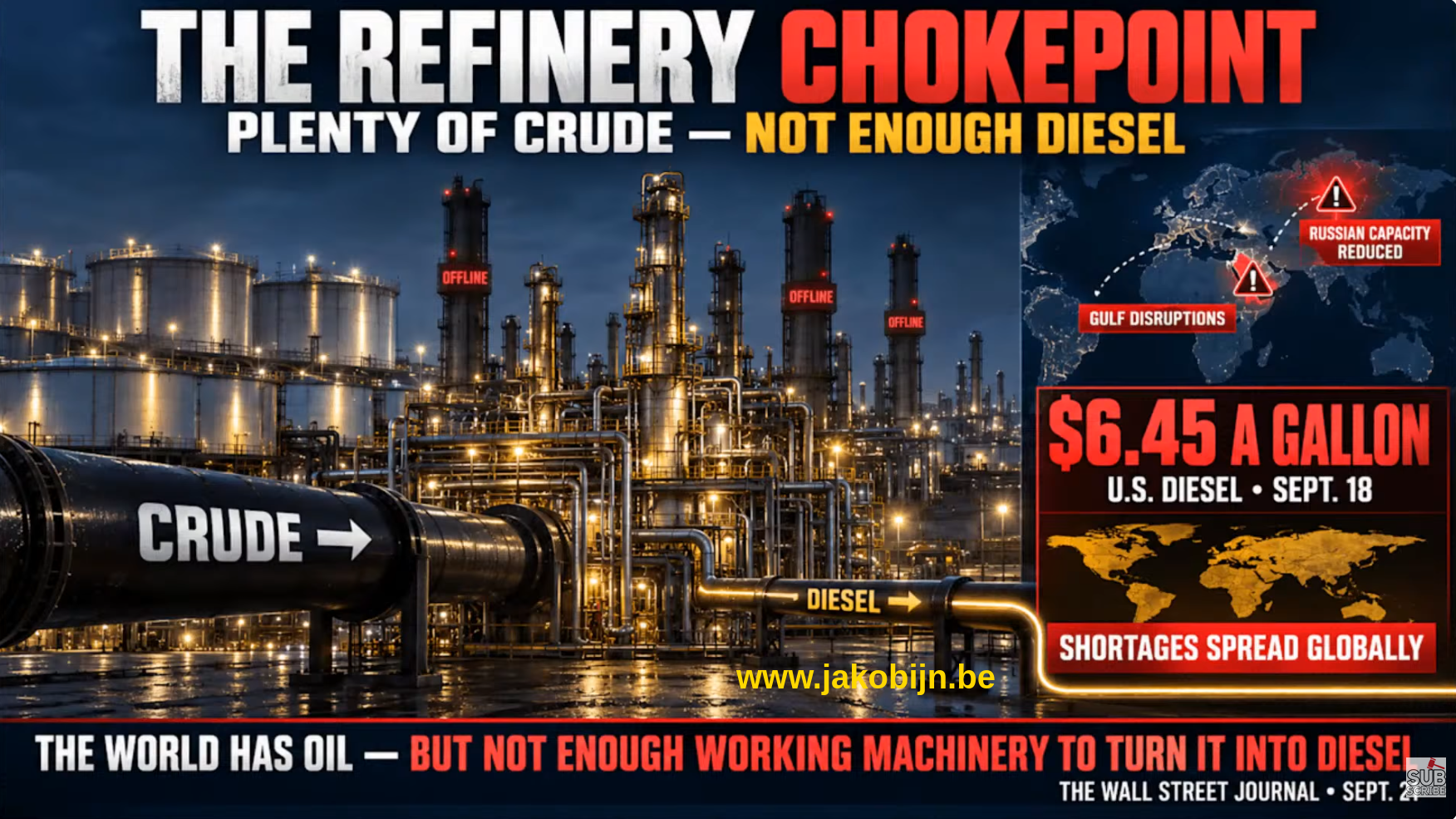
The escalation is further fueled by a new wave of sanctions, popularly called "sanctions from hell", which were recently endorsed by the American government and immediately applied to major Russian banks. At the same time, we see targeted attacks on Russian refineries. Washington has warned that these attacks undermine global diesel production, since Russia was previously an important supplier. Yet these attacks continue, driven by a blind urge to punish Russia, without regard for the catastrophic backlash on the world economy.
Europe is completely unprepared for the consequences. There will be a shortage of half a million barrels per day in the last quarter, and fuel prices will not rise gradually to temper demand, but will strike like a "cliff edge". In parts of France we already see truck drivers standing in long lines at gas stations. The elite is trying to mask this inevitable economic pain with fear campaigns, similar to the staging around the COVID pandemic, where images of army trucks full of coffins were used to sow panic, while the reality was more nuanced.
Here the hard financial reality of European support for Ukraine must be seen. According to official figures from the European Commission, total EU support for Ukraine since the beginning of the war amounts to an astronomical sum of €224.5 billion. An analysis of these figures reveals the scale of resources being pumped out of a weakening European economy:
- €110.3 billion has been provided or guaranteed through the EU budget.
- €77.9 billion consists of military assistance measures.
- Up to €17 billion is intended to help member states with the reception of Ukrainians in the EU.
- €15.5 billion comes from direct support from the EU member states themselves.
- €3.8 billion is financed from the proceeds of frozen Russian assets.
Within the EU budget alone, it concerns €43.3 billion in macro-financial assistance, €42 billion through the "Ukraine Facility", and €14.9 billion through the "Ukraine Support Loan", in addition to billions in humanitarian and bilateral aid. This is an unprecedented transfer of wealth at a time when the European citizen is facing rising energy prices, inflation and the real threat of rationing. The question is justified: what is the strategic return on this €224.5 billion? It has not broken the Russian war effort, it has not disrupted the Russian elections, and it has economically weakened Europe. It is an investment in an illusion of control over a multipolar world that no longer exists.
Part 3: The Saudi Dilemma and the Collapse of a Post-Colonial Construct
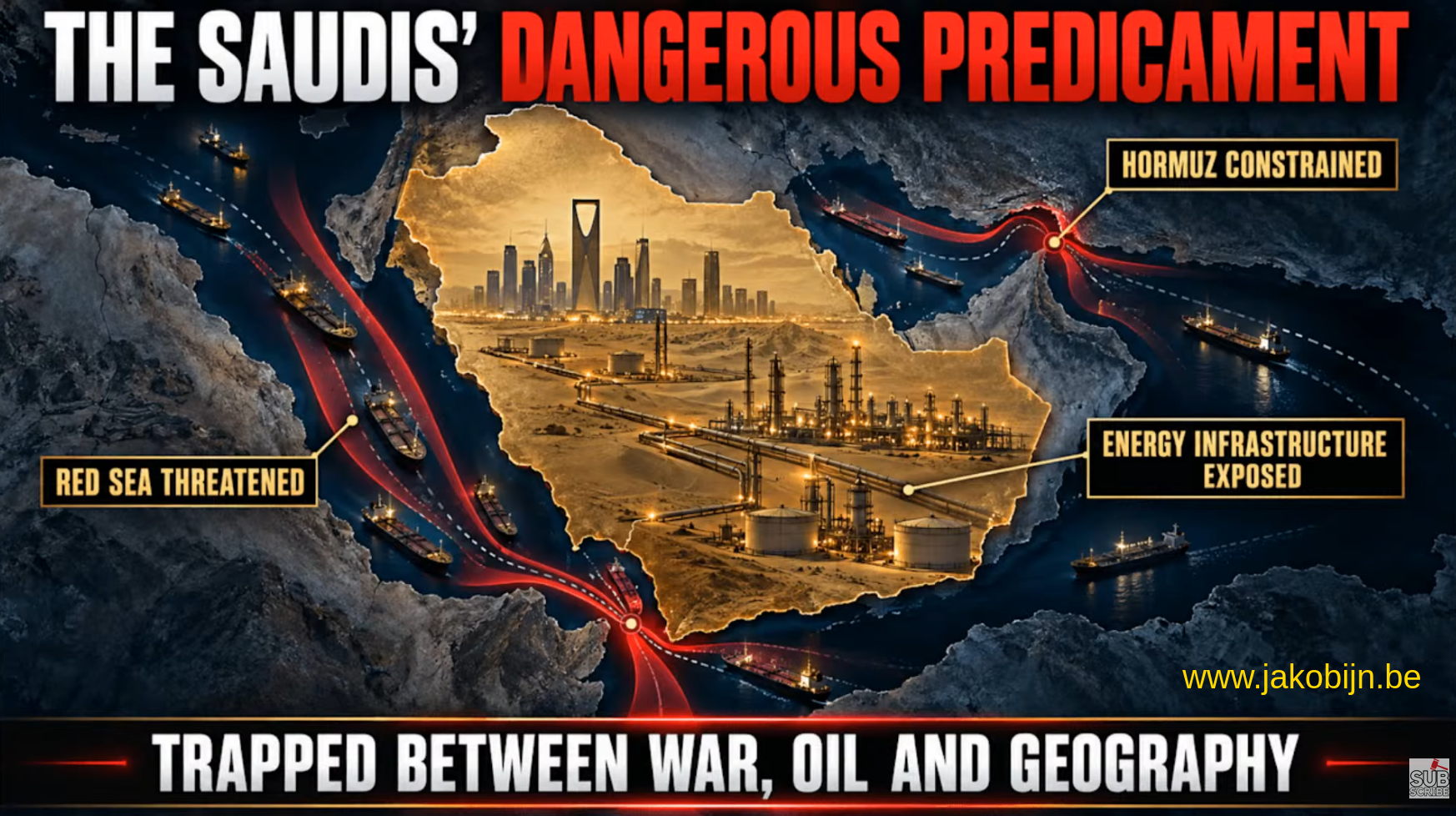
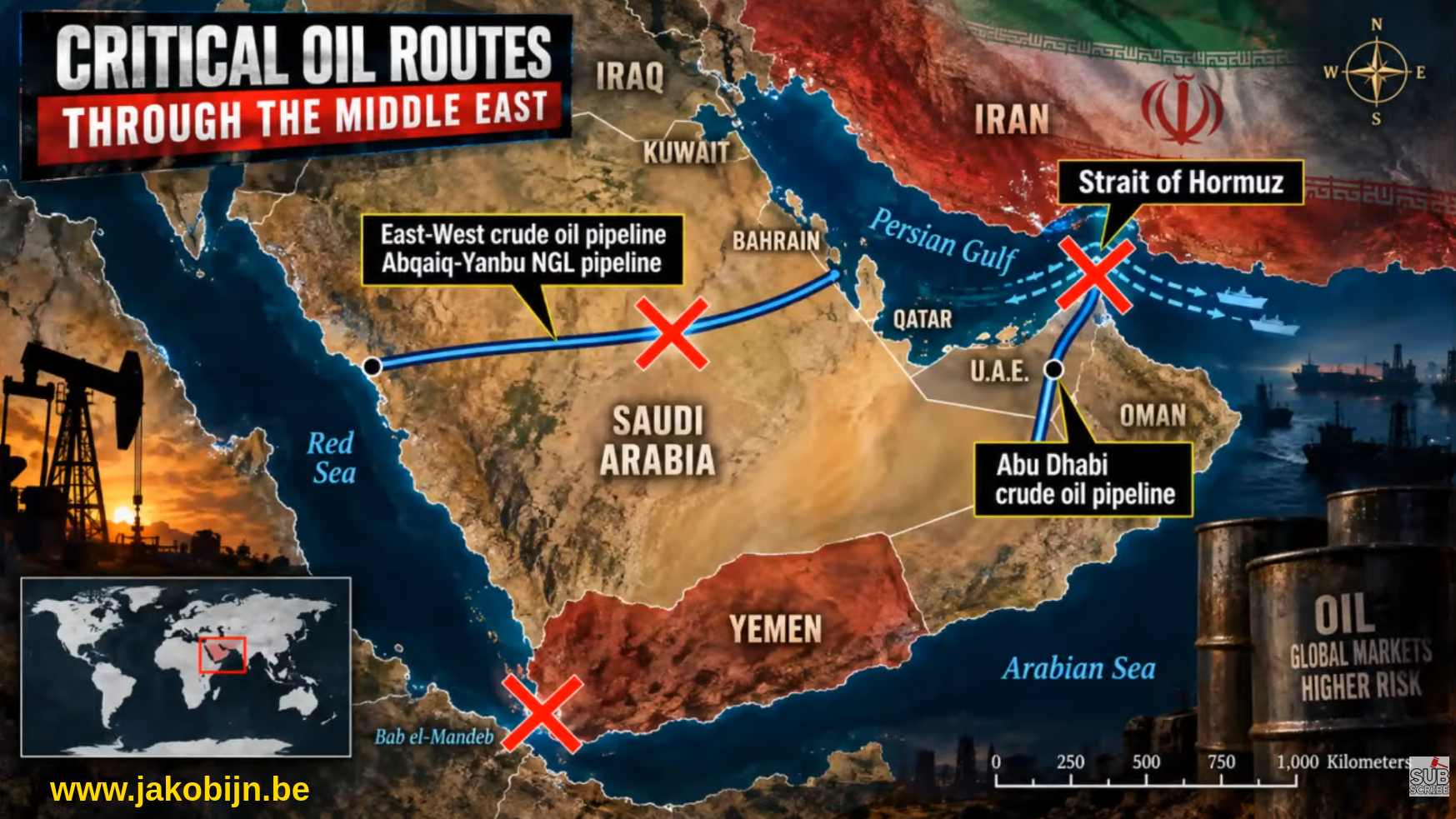
While Europe is stuck in its own sanctions spiral, another geopolitical time bomb is exploding in the Middle East. The position of Saudi Arabia is currently extremely dangerous, a fact that became painfully clear recently when the American president, after initial threats, refrained from a military attack on Houthi targets in Yemen. This turnaround is not so much a sign of peace, but of military realism.
The Saudi attempt to suppress the Houthis (Ansar Allah) through a coalition of tribal militias and mercenaries has failed in a humiliating way. There was no central command, no coordination and no logistics. On the battlefield, these troops were completely destroyed by the Houthis. What's more, there is a major shift taking place among the Yemeni tribes: even tribes that previously opposed the Houthis are now turning against Saudi Arabia, simply because the kingdom no longer has the financial resources to pay them.
The Pentagon has faced this reality and drawn the conclusion that direct American intervention would be disastrous. The Houthis have withdrawn to the most inaccessible mountainous areas of Yemen, from where they can bombard the Strait of Bab el-Mandeb with conventional artillery. They are light-footed, mobile and difficult to target. An American attack would be limited to bombing civilian infrastructure in cities such as Sana'a or Taizz, which would not stop the Houthis, but would spur them to retaliation. And that retaliation would be devastating: the Houthis have advanced missiles and drones, have already shot down a Saudi F-15, and have destroyed the fuel supply of Riyadh airport. An escalation could lay the Saudi energy infrastructure in ruins, with global economic shockwaves as a result.
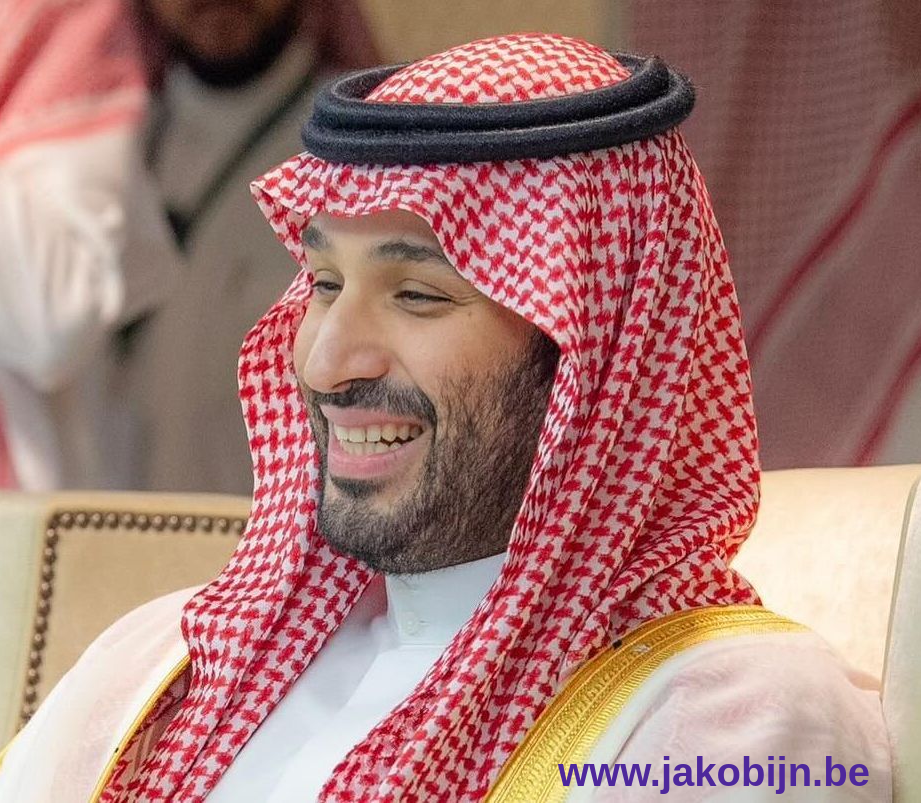
For Crown Prince Mohammed bin Salman (MBS), this is a huge humiliation. His entire security architecture was based on the unconditional support of Washington. The recent decision not to save him reveals the vulnerability of his position. Within his own family, resistance is great; one remembers the Carlton Hotel incident, where he locked up rivals and hung them upside down to get their wealth. Some of these rivals have disappeared or been humiliated, and the traditional tribes have been deprived of their income.
The financial reality of Saudi Arabia is bleak. The enormous reserves that have been built up have largely been spent on prestigious, but economically questionable projects such as Neom. There is no more money to pay contracts, no money to buy loyalty, and even traditional allies in the Gulf are reluctant to buy Saudi assets or shares, except at huge discounts, because they doubt the survival chances of the current regime. The post-colonial structure in the Gulf, of which Saudi Arabia is the pivot, hangs by a thread.
Part 4: The Myth of Saudi Modernization and the Geopolitical Earthquake
In the West, and particularly in the circles of the American political elite, Saudi Arabia is still romanticized as an example of modernization and reform. One sees MBS as a reformer who leads Islam to a "different outcome". This view is a dangerous myth. The reality is that the Saudi regime rests on a single, fragile pillar: one family that has falsified the succession rules. King Salman changed the traditional succession from brother to brother, in favor of his own son, and has thereby alienated most of the royal family.
Historically, this regime is rooted in an extremely puritanical, Wahhabi ideology. This movement was responsible for gruesome massacres in Mecca and Karbala in the 19th century, in which tens of thousands died in the name of the struggle against any form of "innovation" in Islam. Even in modern cities like Jeddah, this austere form of Islam was often detested by the local population. The idea that this regime is the natural, moderate leader of the Islamic world is a historical mistake that the West continues to make because it is blind to reality as long as the "petrodollar" and the oil supply to Wall Street seem guaranteed. But when that guarantee disappears, nothing remains but an empty shell.
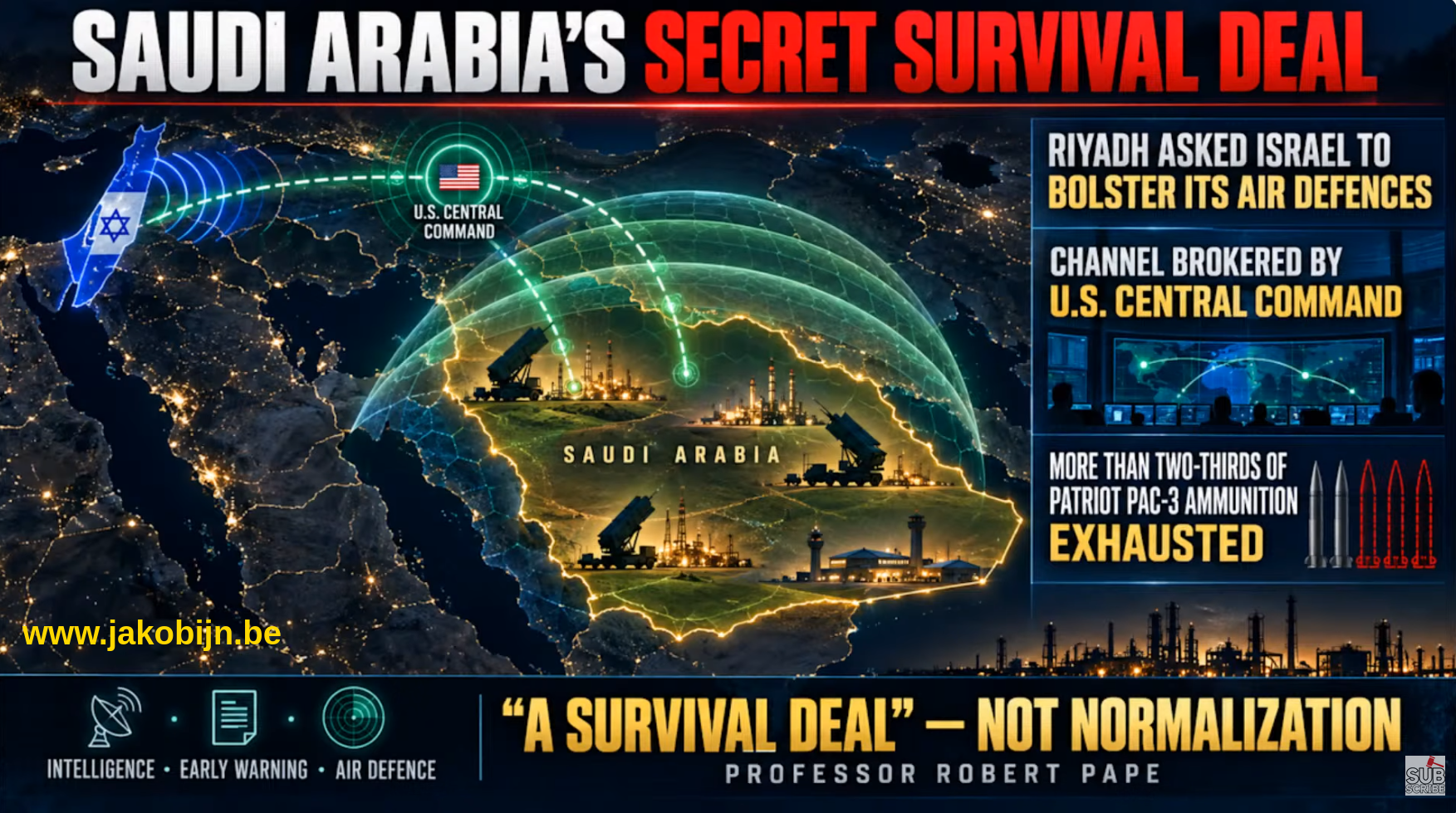
This collapse has direct and profound consequences for Israel. Israel's strategy in recent years was entirely based on the "Abraham Accords": normalizing relations with the Gulf states, with Saudi Arabia as the ultimate prize and pivot. This was to serve to isolate Iran and integrate Israel into the region. That strategy is now seriously faltering. Israel is also directly affected by the global fuel crisis and inflation. Everything, from transport to agriculture, depends on diesel. Prices are rising everywhere, and the Israeli economy cannot escape this global inflationary pressure.
Moreover, Israel must watch as its most important regional partner, Saudi Arabia, becomes paralyzed. The big gamble to build up the Gulf states as a buffer against Iran has failed. At the same time, Iran is reportedly mobilizing a million people in self-sacrifice battalions. Although this is not necessarily intended as preparation for an impossible Western invasion, it serves as a powerful deterrent. For countries like Bahrain and Kuwait, which share or are near the border with Iran, this mobilization is a source of intense fear. Further escalation by the West would not lead to a quick victory, but to an all-encompassing regional war involving Iraq, Iran and the entire Gulf region.
Conclusion: The Price of the Illusion
Alastair Crooke's analysis, supported by the hard figures of the European Union, reveals a pattern of Western policy that is detached from reality. Europe is pumping €224.5 billion into a conflict it cannot win, while its own population is being prepared for shortages, inflation and possible warfare on its own soil. The leaders, confronted with electoral defeats and economic decline, choose fearmongering instead of honest governance.
In the Middle East we see the fatal consequences of a post-colonial architecture that is on the verge of collapse. Saudi Arabia, the supposed pillar of Western influence in the region, turns out to be a financially and politically hollowed-out state, led by a regime that is unable to ensure its own security without the support of an America that is itself increasingly less willing to pay the bill. The myth of Saudi modernization has been punctured, and with its collapse the entire Israeli strategy of regional normalization is faltering.
What remains? The necessity, as stated in the introductory words of the analysis, to understand and reject the initiative of violence. A society that truly wants to be free must not accept the illegitimate use of force by the government as a given. The price of the illusion that the West can continue to set the world order to its hand is paid by the ordinary citizen: in the form of inflation, energy shortage, and the threat of a war that is being fueled by a desperate elite, but won by no one.
It is time for a sober, critical look at the course of Europe and the West. History teaches that regimes that deceive their own population with war propaganda to cover up economic failure ultimately perish from their own hubris. The question is not whether the illusion will burst, but how much damage we allow before we choose a course of diplomacy, economic realism and true freedom, instead of the slavery of an endless war economy.